
Past Conferences
Dr Irit Felsen speaks at the 2024 World Federation of Jewish Holocaust Survivors & Descendants Conference
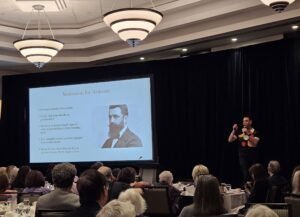
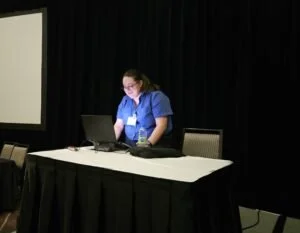
Dr. Irit Felsen joined the WFHS&D 2024 Conference in Toronto, CA to present a plenary talk on How has the Israel/Gaza War been impacting the various generations of the Shoah?
Dr. Irit Felsen joined the WFHS&D 2024 Conference in Toronto, CA to present a plenary talk on How has the Israel/Gaza War been impacting the various generations of the Shoah?
The 2024 Conference was a Great Success!
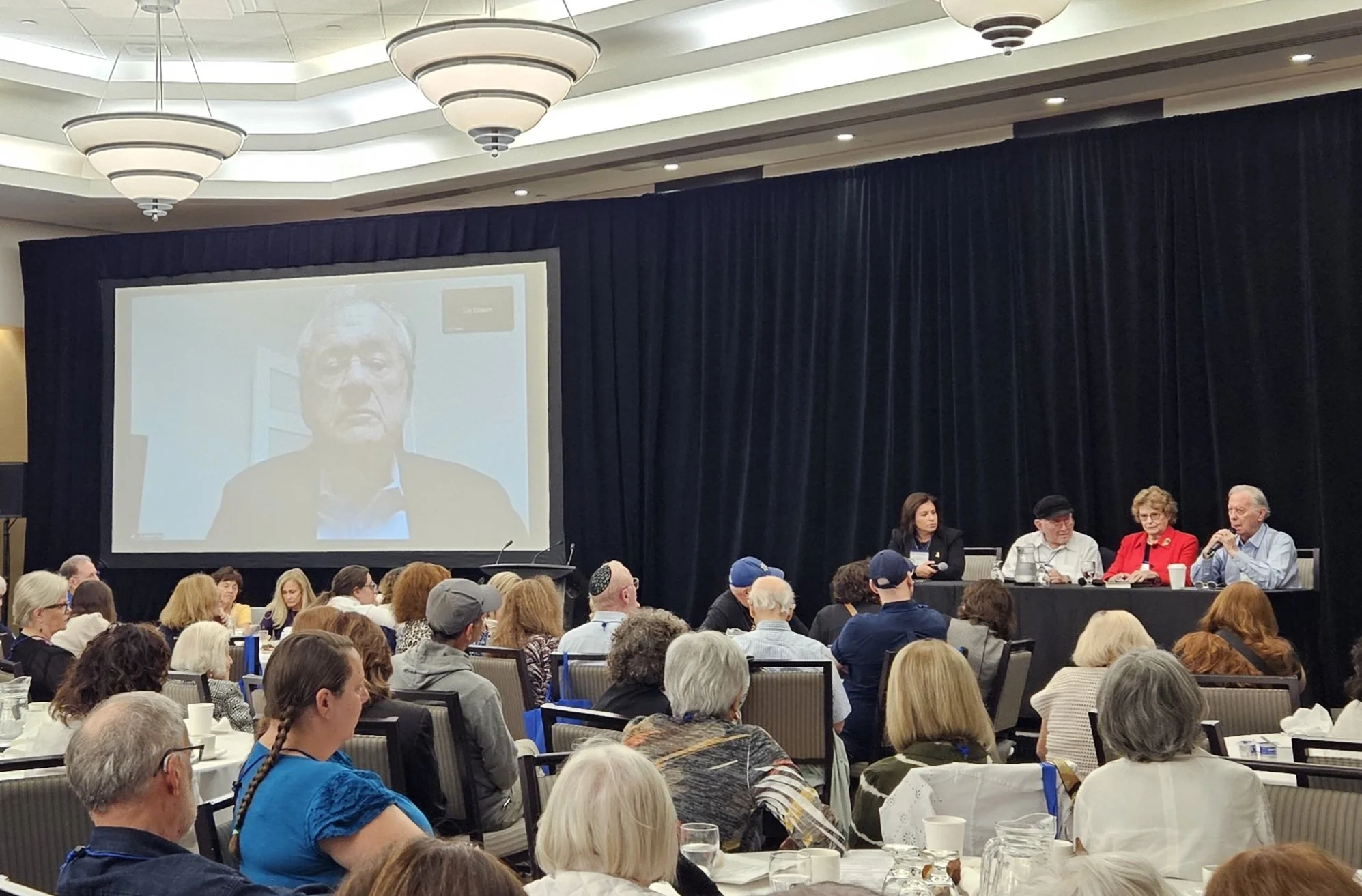
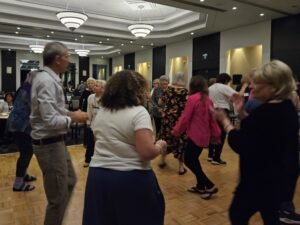
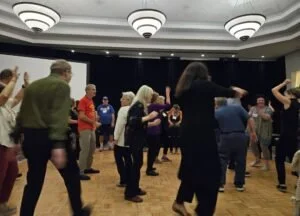
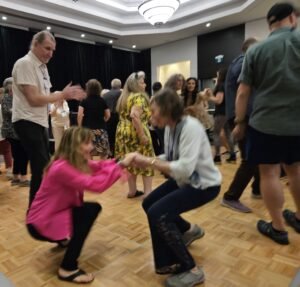
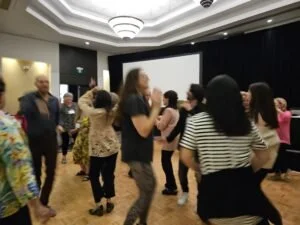
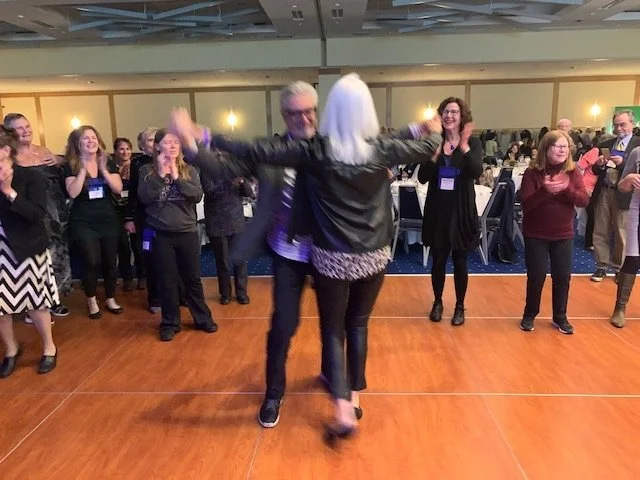
300 Holocaust Survivors and Descendants gathered in Markham, Canada for 3 days of community, making connections, learning from each other, talking, and dancing!
300 Holocaust Survivors and Descendants gathered in Markham, Canada for 3 days of community, making connections, learning from each other, talking, and dancing!
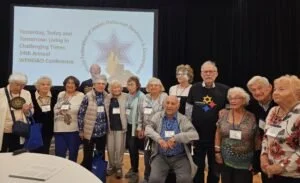
2024 Conference Program
The 2024 World Federation of Jewish Holocaust Survivors & Descendants conference, in conjunction with Generations of the Shoah International and The Kindertransport Association, was held September 20-23, 2024 in Toronto, Canada. The conference’s theme was: “Yesterday, Today and Tomorrow: Living in Challenging Times”.
The 2024 World Federation of Jewish Holocaust Survivors & Descendants conference, in conjunction with Generations of the Shoah International and The Kindertransport Association, was held September 20-23, 2024 in Toronto, Canada. The conference’s theme was: “Yesterday, Today and Tomorrow: Living in Challenging Times”.
2023 Conference Program
The 2023 World Federation of Jewish Holocaust Survivors & Descendants conference, in conjunction with Generations of the Shoah International and The Kindertransport Association, will be held August 25-28 2023 in Washington DC at the Omni Shoreham Hotel. This conference is open only to survivors and descendants and accompanying spouses/partners. Conference co-sponsors include the Child Survivor
The 2023 World Federation of Jewish Holocaust Survivors & Descendants conference, in conjunction with Generations of the Shoah International and The Kindertransport Association, will be held August 25-28 2023 in Washington DC at the Omni Shoreham Hotel. This conference is open only to survivors and descendants and accompanying spouses/partners. Conference co-sponsors include the Child Survivor organization of the DC area, the Generations After, and 3GDC.
For those arriving early, there are special docent led tours of the USHMM Thursday and Friday morning. Pre-registration for these tours is required and limited to 25 people per time slot.
The conference will open officially with check in on Friday afternoon and opportunities to attend Orthodox or Egalitarian Shabbat services followed by greetings from dignitaries and a festive Shabbat dinner. After dinner, attendees will go to informal gatherings by counties of the family’s origin. Kindertransport all generations, and third generation groups will have their own informal sessions.
Saturday’s plenary sessions will be Intergenerational Transmission of Trauma by Dr. Irit Felsen and What is the U.S. Government Doing With Regard to Holocaust Issues? featuring Eli Rosenbaum and Ellen Germain. Panels and seminars on Saturday will include Growing up LGBTQ+ in a Survivor Family, Speakers’ Training, Reclaiming EU Citizenship, and a presentation by the USHMM.
Sunday plenary sessions include Missing Pieces: Growing Up in the Shadow of the Holocaust, a panel presentation about the memoirs written by 14 daughters of Holocaust Survivors who are members of the Generations After group in the Washington, D.C., How Growing Up in a Survivor Family Impacted Our Lives and Work, featuring Rabbi Justin Pines and Amy Spitalnick; and a Claims Conference Update by Greg Schneider. Panels and seminars will include Memoir Writing, How Can I Interview My Family To Document Their Stories, Hitkansut: A New Model of Holocaust Remembrance, and International Holocaust Commemoration.
As always, the heart of the conference will be the many interactive workshops offered on both days for Survivors, Second, Third Generations, Spouses/Partners to get together and talk about the issues that are unique to us. These workshops include: Two Generations Together; What Is there Left To Do That We Haven’t Done Yet; As a 2G What Am I Uniquely Positioned To Do; As 3Gs What will We Do When We Leave This Conference; What Has It Meant To Me To Be Part Of a Survivor Family; How Are Holocaust Experiences Affecting Us Today; How Has Being a Descendant of Holocaust Survivors Affected My Life.
The conference will conclude with a panel of third generation leaders discussing their goals and plans for the future as well as a moving closing ceremony.
Special optional events available are visits to the USHMM for a free self-guided tour, opportunities to arrange appointments to do individual research either before or after the conference, visits to the new Capitol Jewish Museum, and a guided tour of the Shapell Conservation and Research Center, where the USHMM stores its collections. Details to follow!
We encourage you to join us for this Gathering of the Generations! All Survivors and members of Survivor, Second, Third or Fourth Generation Families are invited.
Here is the program as of July 22nd. Schedule is liable to change, so check back closer to the conference date.
CONFERENCE SCHEDULE
WEDNESDAY
11am, 1pm, 3pm Optional tour of the new Capital Jewish Museum – 20 person limit, register in advance (Transportation on your own)
THURSDAY
9:00/9:30 AM Optional docent led tours; limit of 25 Docent led tour of USHMM (Transportation on your own)
9:00 AM -3PM WF Executive Committee Meeting
FRIDAY
9:00/9:30 AM Optional docent led tours; limit of 25 Docent led tour of USHMM (Transportation on your own)
9:00 AM-4PM WF Governing Board Meeting
12:00-6pm Registration
2:00 PM-3 PM Open to all Film discussion with Aviva Kempner
5 -6 PM New at conference Orientation
5-6 PM Facilitators Orientation
6-6:50 PM Open to all Friday night Shabbat services
6:50 PM Candlelighting
7:00 – 7:15 PM Honoring Stefanie Seltzer
7:15 – 8:45 Dinner
8:45-10 PM Informal Get -Togethers by Countries of Origin
Poland
Baltic states/Russia/Central Europe
France/Belgium
Germany/Austria
Netherlands
3Gs
Kindertransport all generations
SATURDAY
7:30- 9:00 AM Breakfast
9:15-10:30 AM Plenary: Transgenerational Transmission of Trauma
10:35 AM-12:20 Survivors only How are Holocaust Experiences Affecting Us Today?
2G only How Has Being a Child of Survivors Affected My Life in General?
2G only How Has Being a Child of Survivors Affected My Life in General?
3G/4G How Has Being a Descendent of Holocaust Survivors Affected My Life
Spouses/Partners What Has It Been Like Being a Part of a Survivor Family and How Has This Affected Me?
Panel Open to All Growing Up LGBTQ+ in a Survivor Family
12:30-1:30 Lunch
1:45-3:00 PM Plenary What are some of the things the US State Department and the Department of Justice are doing for Survivors and to honor the legacy of the Holocaust?
3:15-5:15 PM Survivors only As Survivors, What Are Our Concerns Now?
2G only How Has Being a Child of Survivors Affected Who I Am?
2G only Facing a Future Without Survivors
3G/4G only What Motivates Us to Tell Our Family Stories?
All Generations Speakers Training
5:30-6:30 PM All Generations Reclaiming your ancestral citizenship or considering it?
7 -8:30 PM Dinner
8:45 Havdalah
9-11 PM Music and Dancing
SUNDAY
7:30- 9:00 AM Breakfast
9:15-10:15 AM Plenary Missing Pieces: Growing Up in the Shadow of the Holocaust
10:30 AM –12:00 Survivors only What Do I Want to Tell My Children/Grandchildren/Others About Me Before It’s Too Late?
2G only What Have We Learned Since We First Heard Our Family Stories and What Will Be Our Legacy?
3G Where Do We Go From Here?
Spouses/Partner What has it meant to me to be part of a Survivor family?
Open to All Memoir writing
Open to All How can I interview my family to get their story? USC Shoah Foundation and USHMM share how to interview family members
12:30-1:30 Lunch
2:00-2:45 PM Plenary As 3G’s, How Has Growing Up in a Survivor Family influenced the Work You Do?
3:00-5:00 PM Survivors only We Have Always Been Resilient and Independent, Yet the Future May Mean Loss of Independence. How Do We Cope?
Open to All Reflections on Interfaith Marriage in Survivors’ or Descendants’ Families
All Generations Three Generations Getting to Know Each Other
Panel Open to All International Perspectives on Holocaust Commemoration
Open to All An Innovative Approach to Remembering the Shoah
5:15-6:15 PM Claims Conference Update
6:15-7:00 PM Facilitators only Facilitator Debriefing
7-7:30PM All Candlelighting Memorial Ceremony
7:30- 9PM Dinner
9-11 PM DJ Music and dancing
MONDAY MORNING
7:30- 9:00 AM Breakfast
9:15-10:15 Plenary 3G Panel: Where do we go from here? Looking to the future
10:15-11:00 Plenary for All Closing Ceremony
12:00-4:00 Optional tour ($30) Visit the Shapell Center
St Louis Conference 2022: The US Holocaust Memorial Museum and the USC Shoah Foundation
Preserving Holocaust History Through Artifacts and Research. Experts from the United States Holocaust Memorial Museum will present on how they continue rescuing the evidence of the Holocaust and acquiring materials amid the pandemic, including conducting oral history interviews, and about the meticulous research offered to all. SPEAKERS: James Gilmore, Oral History Curator, Curatorial Acquisitions
Preserving Holocaust History Through Artifacts and Research. Experts from the United States Holocaust Memorial Museum will present on how they continue rescuing the evidence of the Holocaust and acquiring materials amid the pandemic, including conducting oral history interviews, and about the meticulous research offered to all. SPEAKERS: James Gilmore, Oral History Curator, Curatorial Acquisitions and Reference, United States Holocaust Memorial Museum; Jude C. Richter, Research and Reference Specialist, Holocaust Survivors and Victims Resource Center, United States Holocaust Memorial Museum.
USC Shoah Foundation: Keeping Survivor Stories Alive Through Testimony and Technology. In this session you will learn about the organization that Steven Spielberg founded almost 30 years ago to record and preserve the testimonies of Holocaust survivors. You will also experience USC Shoah Foundation’s Dimensions in Testimony, featured on 60 Minutes, that integrates advanced filming techniques, specialized display technologies and next generation natural language processing to create an interactive biography that will allow conversational interactions with survivors far into the future. SPEAKER: Amy Marczewski Carnes, Acting Chief of Staff at USC Shoah Foundation. Moderator: Esther Finder.
To watch the video: vimeo.com/833149427
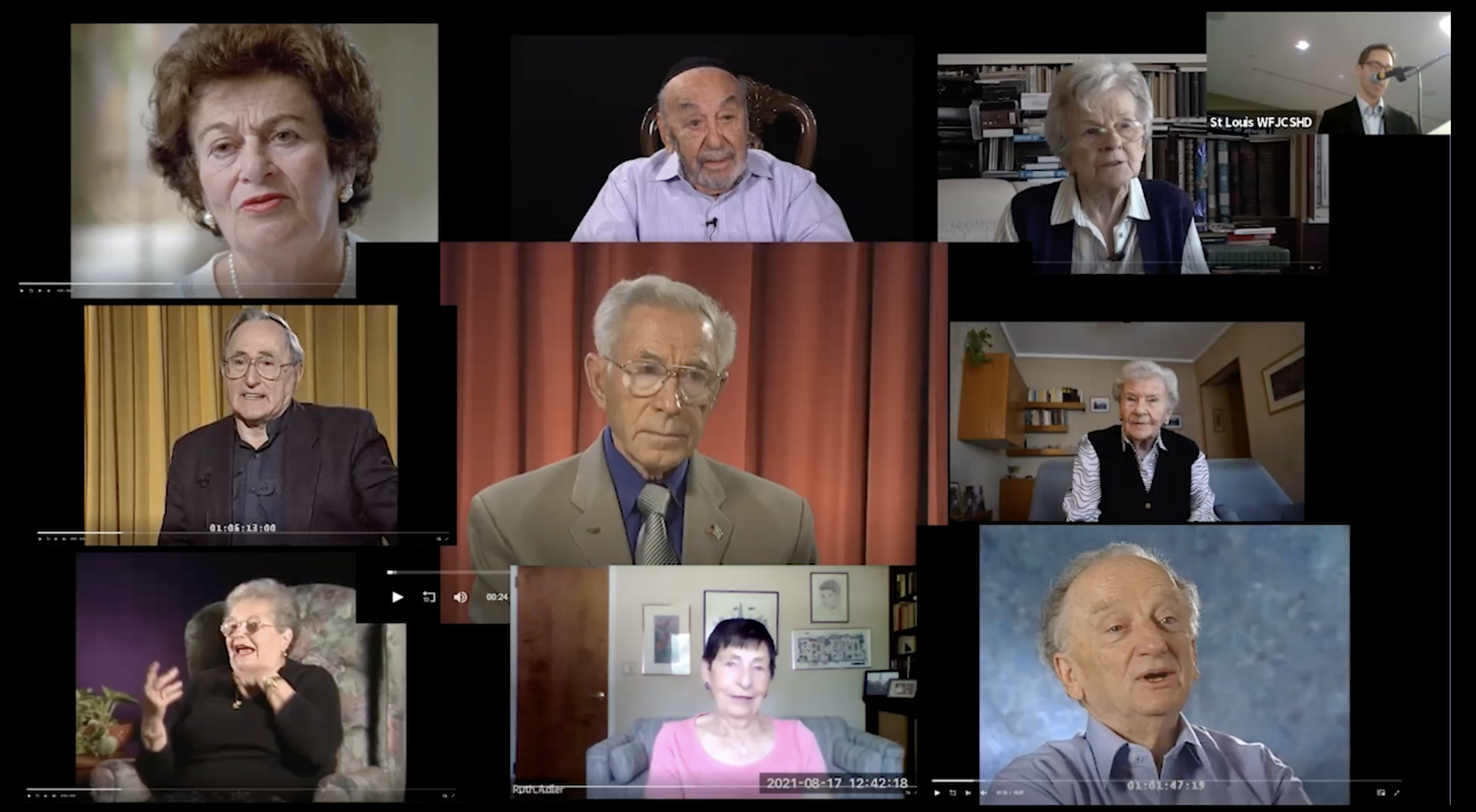
The 2022 WF Conference in St Louis was a great success!
After 2 long years, the community gathered together, 4 generations strong, for an in-person conference. Memories, tears, insights, joy, and dances were shared, longtime connections renewed and new made.
After 2 long years, the community gathered together, 4 generations strong, for an in-person conference. Memories, tears, insights, joy, and dances were shared, longtime connections renewed and new made. 


The Humanitarian Crisis in Ukraine 7.24.2022
Jonathan Ornstein, executive director of the Jewish Community Centre of Krakow, and Rabbi Michael Schudrich, Chief Rabbi of Poland, speak with members of the World Federation of Jewish Child Survivors of the Holocaust and Descendants on the humanitarian crisis in Ukraine. To watch the 80 minute video: https://vimeo.com/734445681
Jonathan Ornstein, executive director of the Jewish Community Centre of Krakow, and Rabbi Michael Schudrich, Chief Rabbi of Poland, speak with members of the World Federation of Jewish Child Survivors of the Holocaust and Descendants on the humanitarian crisis in Ukraine.
To watch the 80 minute video: https://vimeo.com/734445681
Helen Epstein: Drawing on the Past to Meet the Crises of the Present
Helen Epstein, author of the groundbreaking Children of the Holocaust speaks with the WF 4.10.2022. The topic is “Drawing on the past to meet the crises of our present.” She speaks about how her parents’ experiences during the Holocaust were role models for her as she faced Covid-19 and cancer and discusses how similar coping
Helen Epstein, author of the groundbreaking Children of the Holocaust speaks with the WF 4.10.2022. The topic is “Drawing on the past to meet the crises of our present.” She speaks about how her parents’ experiences during the Holocaust were role models for her as she faced Covid-19 and cancer and discusses how similar coping skills help us as we face current crises: Ukraine, censorship, rising antisemitism. After Helen’s 25 minute talk, participants broke out into small groups for discussions.
Helen Epstein, a 2g, is the author of the groundbreaking book Children of the Holocaust. She continued to delve into her mother’s life and the long lasting effects on the next generations in Where She Came From: A Daughter’s Search for Her Mother’s History and The Long Half-Lives of Love and Trauma. Her most recent book is Getting Through It: My Year of Cancer during Covid, out in May 2022. A former professor at New York University, Helen speaks internationally, and was scheduled to be a keynote speaker at the postponed 2020 World Federation conference. You can find Helen’s work at Plunkett Lake Press
To watch the 20 minute video, click here
Dr. Irit Felsen Speaks to the WF
Dr. Irit Felsen speaks on Generations of Holocaust Survivors and “How the Holocaust affects us and why our gatherings mean so much to us” The talk, 1.5 hours, followed by a discussion with participants, took place in the ether, on zoom on November 7, 2021. To watch, click here
Dr. Irit Felsen speaks on Generations of Holocaust Survivors and “How the Holocaust affects us and why our gatherings mean so much to us”
The talk, 1.5 hours, followed by a discussion with participants, took place in the ether, on zoom on November 7, 2021.
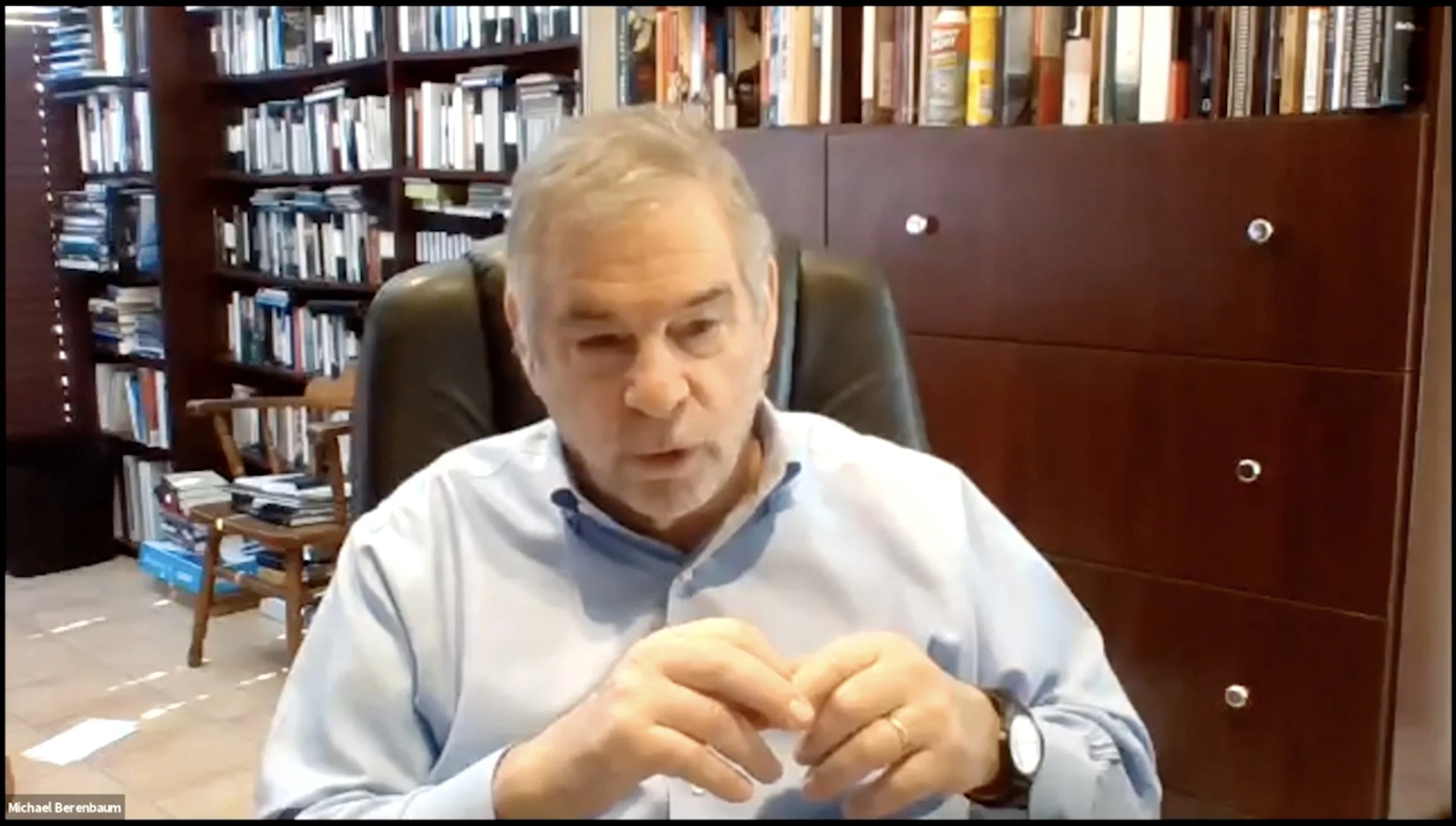
Michael Berenbaum "Making Sense of This Moment in Time"
In the World Federation of Jewish Child Survivors of the Holocaust and Descendants’ first virtual event, Michael Berenbaum speaks on current events to World Federation members on January 17, 2021. This event may now be viewed online here
In the World Federation of Jewish Child Survivors of the Holocaust and Descendants’ first virtual event, Michael Berenbaum speaks on current events to World Federation members on January 17, 2021.
This event may now be viewed online here
2019 WFJCSH&D Conference Vancouver, November 1-4 Robert Krell Keynote
The Future of Our Past: Informing and Inspiring the Next Generations Keynote for 31st Gathering of WFJCSH&D Vancouver, B.C. Canada November 2, 2019 Dear friends, Look around you. Embrace what you see. Already you are sharing a miracle. For how is it possible that we are here? Think of it.
The Future of Our Past: Informing and Inspiring the Next Generations
Keynote for 31st Gathering of WFJCSH&D
Vancouver, B.C. Canada November 2, 2019
Dear friends,
Look around you. Embrace what you see. Already you are sharing a miracle. For how is it possible that we are here? Think of it. We were not meant to be. Survivors are exactly that. Survivors. And if not for them, obviously there would be no children or grandchildren, which is precisely what our enemies had in mind. The genocidal objective was our elimination. The total destruction of European Jewry, followed by the annihilation of Jews in whatever lands subsequently captured and occupied by Nazi Germany.
But here we are, gathered in this room, raising the question as to what brings us here and to what purpose? After all, we lead our lives individually, as best we can. Not as a group. What in the world do we have in common, that impacts our lives, that informs who we are and perhaps, what we do? Are we even aware of what we share, whether consciously or unconsciously? These are complex issues. Let me share what happened when a few local therapists who each had at least one Holocaust survivor parent, approached me some thirty years ago to ask if I would lead a seminar to better prepare them for clients who sought their help and who were second generation sons and daughters of Holocaust survivors. I formed a small group of about six individuals, psychologists and social workers by training, and planned to meet several times.
To my surprise, they began with a challenge, to prove to them that they were themselves in some important way different from children of prewar Canadian Jews. So I asked them if they could think of anything. I was surprised again. They could not. I suggested they describe dinner at home in childhood. Were they told to eat everything on their plate? Well, of course. But so were all Jewish children and millions of Canadian kids. “Sure”, I said, “but which of you were told to eat everything on your plate because ‘when I was in Auschwitz there was nothing to eat’. I also asked if anyone had experienced a parent screaming at night with nightmares. 3 or 4 hands were raised. “What did you do?” They went to comfort their distraught parent. How many Canadian Jewish children of non-survivor families were called upon in this manner? Parenting was often reversed and all my therapist-students had in childhood, responde with some form of care to alleviate parental suffering. Then they entered the helping professions as adults.
In a 2019 book titled, “The Art of Inventing Hope: Intimate Conversations with Ellie Wiesel”, Howard Reich, a second generation son of survivors born in the 1950’s writes “Born after the war, I endure its effects. The children of survivors are almost as traumatized as the survivors themselves. I suffer from an Event I have not even experienced.” He reflects, “I wondered how my parents and the others endured. Where did they find the strength to start over? How did they cope with the overwhelming destruction of their families, friends, and shtetl? Why did almost no one help them? How was it possible to believe in God after the Holocaust? Or during? Why did the survivors have children? Why didn’t the world want to hear the survivors’ stories after the war? And Reich raises other questions, including “What did we lose by not having grandparents? How do we manage being involuntary inheritors of tragedy, grief, and heroism? How has the legacy affected us? How should we speak of the Holocaust today? What is our responsibility?”
I am myself a Holocaust survivor, having been hidden between ages 2 and 5 with a Christian family in The Hague, Holland. But because I had the good fortune that my parents survived separately in hiding, I was returned to them. At that moment I became also second generation and behaved as a child of survivors. I did everything I could to comfort them. They had lost their parents, brothers and sisters. I was not yet aware of my losses. I could not, as a six year old conceptualize what it meant to have grandparents, aunts and uncles, a complete family. Is that perhaps why today I try to be the grandfather I would have wanted? But my parents had lost everyone. In 1945 they had only me and one nephew, my first cousin, son of my father’s sister, Mania, who was murdered in Sobibor. My brother was born 16 years later in Canada.
So for 16 years I was an only child whose responsibility was not to add to the grief/sorrow/tsures of my struggling parents. Hence I was compliant, studied hard, kept illness to myself, played piano and practiced so as not to waste their money, expressed no fears even when scared to death, ate what I was given and made no demands. Twenty years later, after completing my psychiatry residency in the United States, I returned to Vancouver despite attractive offers in the US but I felt obliged to return home to be near them. Which I did. Then I looked after them as they aged. My father required much support and care for about 10 years until he passed at age 82. When my father languished in the Jewish home for the aged and I visited, he would point to a caretaker he loved andwho had been a family friend and whisper, “Rob, watch out for her. She is S.S.”
Please note also that for a young child survivor with parents, or a second generation child born in the 40’s and 50’s, the death of a parent is not infrequently the first death experienced personally. Without grandparents, aunts and uncles to lose and mourn, it is the fate of we children of survivors to live immersed in stories and memories of multiple, gruesome deaths, yet not encounter death personally until age 50 or 60. When my father died, I was 55. When my mother died, I was 67.
I lived my early postwar llife primarily as a second generation person, and buried my childhood survival as secondary in the story of survival until I realized my more authentic existence as a first generation survivor. One day in Jerusalem, at the World Gathering of Jewish Holocaust Survivors in 1981, everything changed for me. When one makes a momentous self-discovery, it can be a life-changing experience. I discovered the existence of child Holocaust survivors.
I had come to Jerusalem that year for many reasons, not only for the Gathering. The primary reason was to honour my rescuers, Albert, Violette and Nora Munnik, all of whom had been inscribed among the righteous at Yad Vashem. My dear “Vader” had passed away. But Moeder and Nora, my wartime sister, were with me in 1981 to plant a tree and to be recognized at a ceremony in Yad Vashem’s Hall of Remembrance. My parents, Leo and Emmy Krell, were there, as was my younger brother, accompanied by his wife. At one point during the ceremony in the Hall of Remembrance, I looked up during the chanting of El Malei Rachamim and through my tears saw Moeder at my side and my mother standing at the railing opposite. Two mothers – one who gave me into hiding to save my life, the other who accepted me, and thereby did save my life.
One of the opening speeches at the Gathering caught my attention. I heard, “My name is Israel Meir Lau, and I am the Chief Rabbi of Netanya. My father, the Rabbi of Piotrowsk was murdered at Treblinka, my mother died of hunger at Ravensbrück. I was the youngest survivor of Buchenwald. I was eight years old.”
It was as if lightning had struck. Rabbi Lau was eight-year old Lulek at liberation! In 1945 my first cousin Nallie was six, my second cousin Milly eight, and I was five. We were the children who had survived the Holocaust, child survivors of the Shoah. So that is what I discovered. And of course, it is likely that other children somewhere had made a similar discovery but I had not heard of them nor seen any identify themselves as child Holocaust survivors.
I was aware of the adult survivors. They were rooted in their identity as Holocaust survivors and of course had been the dynamic force behind the 1981 World Gathering in Jerusalem, including such leaders as Ben and Vladka Meed, Ernest Michel and Eli Zborowski amongst others.
And the Second Generation had announced itself with conferences and gatherings in the late 1970’s which also saw the publication of Helen Epstein’s ground breaking book Children of the Holocaust: Conversations with the Sons and Daughters of Survivors. Therefore, the adult survivors had found an identity, as had the Second Generation.
But where were we, the children? Most of us had been in hiding. Very few little ones survived concentration camps making Rabbi Lau, at age eight, a very rare exception. Of the 1,000 children found at Buchenwald, most were adolescents aged twelve or thirteen and older.
At Écouis, where 426 of the children were taken by the Oeuvre de Secours aux Enfants French Rescue Society, the staff had prepared little beds but they received no little ones.
And these children sent there for their recovery were told many things, some insulting and derogatory. Apparently a psychiatrist or psychologist told the gathered assembly of children that they would never recover and by other doctors that they might not live long, and by officials that they were probably sociopaths. (Who but sociopaths could possibly have survived? Or so they thought). I have been told this by several boys who were there.
But they were also instructed despite the various dire and ominous predictions, to leave the past behind and get on with the future. Fortunately, they had some wonderful and optimistic social workers like Judith Hemmendinger and her assistant Niny Cohen, and teachers like Manfred Reingwitz who tamed them, nurtured them, and salvaged most of them. These camp children included Elie Wiesel (1986 Nobel Peace Prize Laureate), Israel Meir Lau (Ashkenazi Chief Rabbi of Israel) and Naphtali Lau-Lavie (Israel’s Consul General to New York) and our own Robbie Waisman.
What had happened to children saved in hiding? I know of some early interviews of children in the post-war years. Indeed, there were photos in LIFE magazine of some who arrived to America. Forty-eight such children arrived to Vancouver, Canada as early as 1947. That is when Mariette Doduck, my co-chair of this gathering, arrived.
What did children in Canada or the United States or Australia or in Israel do? They remained hidden. Hiding was difficult during the war, much easier after. The few who tried to talk did so at great personal risk. They did not really wish to reveal themselves as different; as having coped with monstrous experiences, enormous losses, and monumental insecurity. We wanted to look and be normal. In any case, few adults, even mental health professionals, especially mental health professionals, did not ask about their experiences and advised them to forget the unforgettable. And worse, children were told that because of their young age, they likely had no memories and therefore did not suffer.
Somehow, mental health professionals colluded in this madness. Before the war, a single childhood trauma was viewed with great alarm and resulted in years of psychoanalysis and psychotherapy but this obvious massive psychological disaster was virtually ignored. Perhaps it was inevitable that no one knew what to do with us, how to treat us, even to face us. We had been surrounded by death. 93% of all Jewish children under Nazi domination were murdered. We are less than 1 of 10 left. What absolutely no-one recognized was that we were children who grew up over-night. In mortal danger, we had to adapt to circumstances beyond imagination. We became elderly children. Childhood was erased. Decisions had to be made, languages learned, Christianity embraced, rituals mastered. Emotions were stifled, illnesses ignored, abuses unreported. Children remade their lives to adapt to circumstances and largely it was not enough. One slip, one mistake, one failure of luck, meant betrayal and death.
And then we were cast aside – we little ones who were instructed to live as if nothing had happened. We became the children of silence. Silence became our language. And it lasted for a biblical fourty years, given that it was not until the 1980’s that the traumas of early childhood could no longer be contained. When you tried to talk about your experiences and fears, you were told to forget the past and get on with life. Unfortunately it is the past that must be recaptured and remembered in order to carve a path toward life. In order to create a future, we had to embrace the past.
A few of us did that. Frieda Grayzel in Massachusetts, Stefanie Seltzer in Pennsylvania, and I in Los Angeles with Sarah Moskovitz. Child survivor groups formed as did eventually, this gathering. A ground-breaking event was the 1991 Hidden Child/ADL Conference in New York which attracted 1600 participants, largely child survivors. It was there where in the various workshops, Child Holocaust survivors revealed their struggles to others with similar preoccupations. It was a matter of, “Thank God, I thought I was crazy. But you were crazy with the same issues. So perhaps we are normal” How true. I wrote many years ago, that if a Holocaust survivor did not suffer depressions, nightmares, insomnia, flashbacks, and unexpected bouts of sadness and crying fits, or did not react to sirens, barking dogs, explosions, or the sight on TV of fleeing refugees and destitute children, then they were abnormal. After their experiences it was not normal to be normal. For them, the psychopathology associated with PTSD was neither a psychiatric disorder nor an explanation. Whatever the symptom, it was simply a normal consequence of abnomal experiences.
As a 2 year old in hiding for 3 years, I forgot my parents and became Robbie Munnik. Even though I had thick, black, curly hair in a family of blondes, I felt at home with my family. At liberation, when my parents came for me, I did not want to go. I protested losing my parents a second time. I recall wailing, a cry of anguish. It lasted a long time, for in hiding I had not cried for three years. No, liberation did not feel liberating for a Jewish child.
I knew somehow that Nallie, Milly and I were not normal. We played as if we were. But how could we be normal? Nallie lost his family. He was an orphan. Milly, whose family narrowly escaped to Switzerland, returned to Holland to learn that her mother and father’s sisters and brothers had all been murdered, with their little children.
Death lurked everywhere. The few survivors of the 20,000 strong Jewish community of The Hague, slowly returned, many via our home in which I heard their stories, told in Yiddish and ably translated by Milly. Those stories have never left me. As elderly children who had grown up overnight, sadly, we understood too much. We have spent a lifetime trying to recapture childhood, even some of us who are now indeed growing elderly. But here is the good news, my tennis game is improving.
What happened after I discovered child Holocaust survivors through Rabbi Lau’s words in 1981? In 1982, I had the good fortune of meeting Sarah Moskovitz who was writing a book on child survivors, Love Despite Hate: Child Survivors of the Holocaust and Their Adult Lives. She gave me a draft to read, and it was published in 1983. Sarah discussed the lives of 24 infants and children found at Terezin. They were brought to Lingfield, England for their recovery and were looked after by a social worker, Alice Goldberger. Sarah had met her in England, heard their story, and then tracked each and every one of these children about thirty-five years later, recording what had happened to them over their lifetime into the late 1970’s.
Sarah was a Professor of Developmental Psychology at Cal State, Northridge. Her interest in children connected to her experiences as a child living in an American family with relatives in France who were lost. Sarah’s parents were consumed with grief. She founded a group for child survivors to meet and heal. I attended the first meeting in Los Angeles in 1982 and she asked me to return to Los Angeles in 1983 and help to convince the fledgling group of the need to be together. There had been reluctance. On that day, several child survivors committed to working together and the Child Holocaust Survivors of Los Angeles was founded, growing to a membership of 300. Daisy Miller, a founder and activist in this group has told me it may have reached 500 at one time. The Oxnard conference held in 1990 was one of the first international meetings of child Holocaust survivors, and about a dozen of the Lingfield children attended.
Judith Kestenberg, a psychoanalyst, had been interviewing child survivors of the Holocaust and this led from her research, to therapy groups formed with the assistance of Eva Fogelman and Ira Brenner. Stephanie Seltzer, of Philadelphia, organized a meeting at Lancaster, Pennsylvania in 1987. So throughout the 1980’s there were activities leading to the gatherings of children. And after 1988, we continued to meet annually in different geographic locations. We have been in various places including Los Angeles, New York, Las Vegas, Houston, Cleveland, Toronto, Montreal, Detroit, Prague, Warsaw, Berlin, Amsterdam and three times in Jerusalem.
It has been a rocky road. After all, we children, those less than age 16 at liberation in 1945, were largely at the mercy of adults with respect to where we would end up in the world. The slightly older survivor, approximately age 17 and older, participated in the decision as to what to do next with their lives, whether to make Aliyah, how to reconnect with any surviving family, finding work in order to re-establish a sense of security. Young adults frequently married in the displaced persons camps and for several years these refugees had the highest birthrate in the world.
The child survivors were more or less at the mercy of those who were willing to take them into their homes and were scattered around the world, mostly in Israel, but also in Australia, Britain, Switzerland, the United States, Canada and South America.
My good fortune was that our family of three emigrated to Canada in 1951. It did not take long to see that Canada was a smorgasbord of opportunity, the opportunity to work, earn money, support myself in my studies and that, I could largely on my own forge my path to becoming a medical doctor, psychiatrist and child psychiatrist. Eventually I became a professor of psychiatry at the University of British Columbia.
However, while preoccupied with my studies for an entire decade, I could not shake off the memories of the Shoah. There were simply too many reminders. For one, the Munnik family remained an integral part of our lives and Moeder and Vader attended my graduation from medical school in 1965 and my wedding to Marilyn in 1971. My sister Nora, who is alive and well at age 89, has recently been to three simchas in our family. I am very fortunate to have retained these strong connections. My Moeder had a great influence on my life even after the war. She liked to tell me that I was a child saved to help other children. Perhaps my career choices originated with her hopes and expectations. I must be one of the few Jewish boys who was told to become a doctor not by a Jewish mother, rather by a Christian one.
She was a kind woman, reserved and shy. Yet, at our wedding she spontaneously spoke to the 400 guests in Dutch, a speech which I translated. In essence she said: “I have no understanding of the Holocaust; that is the domain of historians. All I know about the Holocaust is that it must have been God’s way to give me a son.”
I met Professor Walter Kohn when I was in Santa Barbara, invited to give a lecture on Child Holocaust Survivors and participate in a plenary on Genocide. That night, at dinner with the Federation executive as well as Professor Kohn and his wife, Mara, the daughter of Roman Vishniac, (whose pre-war images comprise the book, “A Vanished World”), Walter Kohn told the story of his arrival to England. He had been rescued from Vienna on a Kindertransport shortly after the Anschluss, then sent on to Canada with hundreds of other Jewish adolescents and interned as an “enemy alien”. He applied to the UBC Department of Physics writing that he was learning English and besides, that he knew a ’little math’. He received a very harsh rejection. So he took an MA in applied mathematics at the University of Toronto, then a PhD in Physics from Harvard in 1948, went to UCal, San Diego in 1960, and became Professor of Physics at Santa Barbara and was awarded a Nobel Prize in Chemistry. When I asked him as to his status as a Holocaust survivor, he modestly declined that definition. Both of his parents had been murdered and he had lost most of his family but felt he had not himself earned the designation of “survivor”.
About ten years later, when he visited Vancouver for our ”Enemy Aliens” exhibition at the Vancouver Holocaust Education Center I asked him whether he had defined his survivorhood. He thought deeply and replied, “If pressed to define myself, I think of myself as a man of special responsibility “. And now I see before me not necessarily a clearly defined generational sequence so much as a group of people impacted by this massive catastrophe whom have been handed a responsibility.
Because of my self-discovery as a child Holocaust survivor, I felt an obligation. I am a person with a special responsibility. As a result I have been to the vast majority of these Gatherings, often serving as a keynote speaker in order to kick off the conference that I know will be filled with workshops and deliberations that are meaningful to yourselves and to your sons and daughters and grandchildren. That has been a special privilege in my life. I have also written about what makes us unique and want to mention just a couple of themes briefly for your consideration.
One theme we share is memory. Depending on our age, it is a memory of fragments and pieces. Very few of us possess a continuing narrative within our minds as to our precise experiences. I know that it has been helpful for some to put those pieces into a chronologic timeline for that not only strengthens memory but it strengthens personal identity. For some, that is a lifelong struggle. I was reminded of the effects of a fragmented memory when I delivered a Kristallnacht commemorative address some years ago here in Vancouver. I seldom speak so publicly to our own community. I usually go to schools. This time, my family was in the front row and our three daughters were crying. After the talk, I asked them why. After all they know my history, met my Dutch Christian family, especially my sister Nora and they knew of my involvement and commitment to the Jewish community and to Shoah education. But for this event, I told my story in sequence. They said, “We have only heard fragments and pieces of your life. But you never shared the experiences in its entirety. This was the first time that we understood the impact on your life and some of that impact on us.” So for those of you who have not done so and still can, share your story, as completely as you are able to.
A related problem was the inability of Holocaust survivors to find the right time, the right words, to tell their children. Generally, the survivors wanted to protect their children from their memories as much or more, as the children wanted to protect their parents from the pain of memory. So it was hard for the first generation to speak with the second generation, for those conversations were so frequently aborted. The second generation learned not to ask. How astonishing for them to see their children, the third generation grandchildren innocently pose similar questions and elicit a welcoming response. “Zaideh, Bubby, I am doing a project for school on our family and I have some questions about what happened during the war.”
I have heard many complaints from second generation who have no knowledge of their family’s past, and I urged them to send their children as emissaries, ‘schlichim’ on a mission of fact finding. They return with names, places of origin, descriptions of life (and of death), stories of defeat and loss, and of courage and heroism. They are enriched forever by knowing, for they are alive because their grandparents, against all odds, made it.
Another major and contentious issue has been the pursuit of faith and spirituality. After all, we were persecuted for being Jews, often not knowing what it was to be a Jew. In fact, some of us had no Jewish education to rely on for our identity and in any case were forbidden to mention it in order to survive. The road back to securing a firm foundation based on Jewish tradition and Jewish identity has been for many a life long struggle.
Upon arrival in Canada in 1951, my father did take me to synagogue but only to tell me that he did so because his father had taken him to synagogue but that I should have no expectation of seeing him pray, ever. And he did not.
I found my way back to Judaism through having joined Habonim, an organization that helped me to develop my attachment to Israel and to find my first Jewish friends, friendships that have lasted for a lifetime. My way back to Judaism was a complicated and slow process. But I have tried and try a little more each year. Marilyn and I are the lucky parents of three daughters, who have all committed to their Judaism and married within the faith. We have nine grandchildren, all of whom have attended Jewish day schools.
Confronted with adversity after survival, and finding the strength to cope with life’s complexities, we have somehow reached this stage. What now? What do we do as aging child Holocaust survivors who must derive from our complicated lives, the necessary guidelines for our children and grandchildren? Perhaps just a few messages.
Do not forget what Israel means to us. Never assume that all is self-evident. Share with them how we regained pride in being Jewish and how much the State of Israel contributed to that pride. We were once children who were hunted for being Jews, a condition over which we had no choice but for which we were shamed and persecuted. Remind your children and grandchildren that without Israel, their opportunities for success will again be limited. Israel provides the antidote to being and feeling powerless. We are the sum total of our experiences and given the richness of those experiences, our observations must be provided to succeeding generations. That is our responsibility. We cannot stand aside and assume that they will learn from our silence. Silence served us at one point, but since our emergence, we must share that which we know, and that which we feel so passionately. And what precisely is it that we must try to transmit?
At least this. We cannot afford to grow complacent. Complacency is a greater danger to us than the actions of our enemies. Holocaust education is a necessity, not merely an option. It is dangerous when professionals and politicians are unaware of what happened, what became possible when the best legal system to that time was perverted into laws of discrimination and prejudice and when the medical system envied by the world, became an instrument of murder. After the Shoah, nothing can be viewed in the same light as before. Architects designed, engineers constructed, and slave labour was used to build factories of death. There must not be a School of Theology, or Department of Philosphy, that ignores the complicity of the church or the involvement of philosophers. The Shoah was a wound inflicted on us that holds meaning for everyone afflicted with the scourge of racism and prejudice.
A dear friend, Professor Tsung-yi Lin, a psychiatrist who had been the head of psychiatry in Taiwan and then came to UBC as my colleague, told me that all one needed to get through life, was one friend and one teacher. Chinese culture of thousands of years made me assume that we too would have noted this. So I asked our Rabbi who said, “Of course. In Pirkei Avot (the sayings of the fathers) it states: “Find yourself a friend and a teacher”. It was my good fortune to have several great friends and several great teachers. One was Elie Wiesel, survivor of Auschwitz and Buchenwald who in 1986 was awarded the Nobel Peace prize and with whom I spent nearly two days on my own on his invitation when he was in Vancouver in 1978. I talked with him and heard him speak and noted his manner, his mastery of silence, and of listening.
I had his book, “Souls on Fire: Portraits and Legends of Hasidic Masters”. He inscribed it, “For Marilyn and Rob – Souls on Fire”, with affection, November 7, 1978. It was true. He confirmed for me that indeed my soul was on fire. My motivation was burnt into me from all I had learned and heard. How should we do the same with you-inspire you-but with less pain? How shall we provide you with the will to remember and transmit our stories and teach new generations of what we know is possible when evil reigns?
How can we teach as Elie did, that when he fought for the release of Soviet Jews, or went to Sarajevo as an emissary for peace, or to Cambodia out of concern for the victims of genocide, that he made the point of stating, “I am here as a Jew”. He did not say he was there as a humanist or human rights activist. That is a given within Judaism. To be a Jew carries with it the responsibility to act as he did.
And what resonated particularly, was Elie’s statement, “People will do wonderful things if you tell the right stories”.
So l will conclude with a story, a Canadian story that involves young people.
On September 26, 2017, Canada’s National Holocaust monument was inaugurated in Ottawa, the nation’s capital, in the presence of Prime Minister Trudeau. Ten years earlier, 18 year old Laura Grosman was upset to discover that of all Allied countries, Canada had no such monument dedicated to the memory of the Holocaust. She lobbied members of parliament and a private member’s bill was introduced in 2007. Very few are voted on. There was a change of government. The bill was dropped.
It was re-introduced by a young MP from Alberta, the honourable Tim Uppal, a turban-wearing Sikh who shepherded it along in the Conservative government of Stephen Harper, a great friend of Israel and of Canada’s Jewish community. On May 24, 2011 the bill was signed. Only 4 of 448 bills introduced were passed.
Now the story behind the story.
When Tim Uppal visited our Vancouver Holocaust Education Center and announced that the monument would be built, he shared that the Shoah was familiar to him. He understood. How? His wife Kivan, who is also Sikh, had joined a Jewish friend on the March of the Living when she was a teen-ager. She retained a strong connection to a Rabbi on the march, and calls him “her Rabbi”. Therefore, the honourable Tim Uppal and his wife were educated as to the meaning of the Shoah. They knew what to do to help protect Canadians from racism.
It was young people, a next generation who were largely responsible for this massive accomplishment. From the sky one sees an enormous Magen David, with each triangle representing different program areas, surrounding a central gathering place that can hold up to 1000 people. A stair of hope rises to another area from which one can see the Parliament Buildings and acknowledges the Canadian survivors who have contributed so much to Canada in their important role in exposing the dangers of state sponsored genocide. The monument is located near the War Musem and only one mile from Paliament Hill. It was designed by Daniel Libeskind, a child of Holocaust survivors. It was young people who were responsible for this massive accomplishment.
We can never really know whose lives we touch with our stories, but they must be told by us so long as we have the strength to tell. Then it falls to our descendants. Our responsibility will be yours. That is our legacy to you.
2019 WFJCSH&D Conference Vancouver, November 1-4
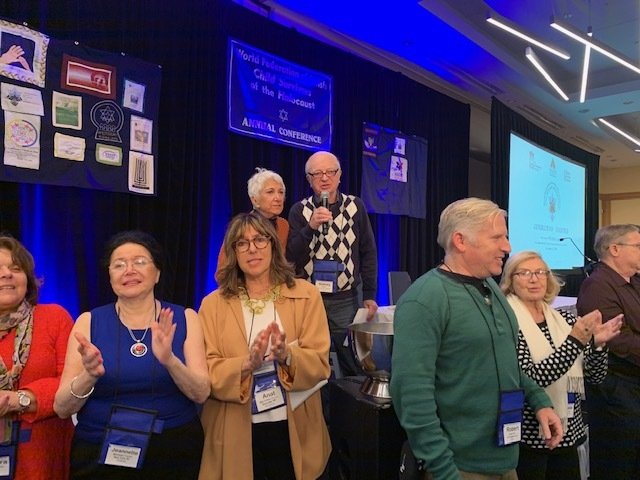
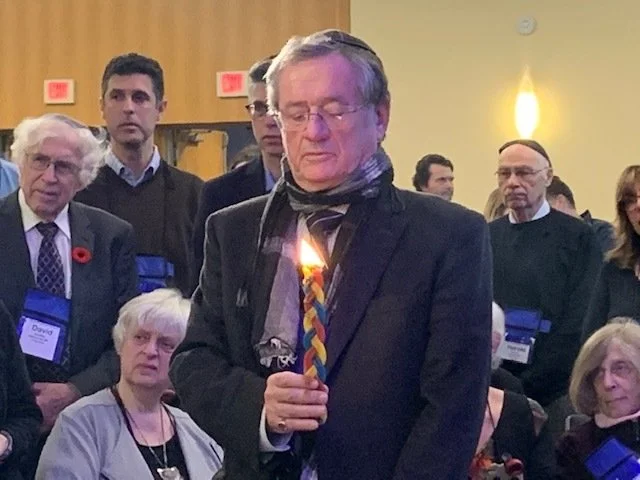
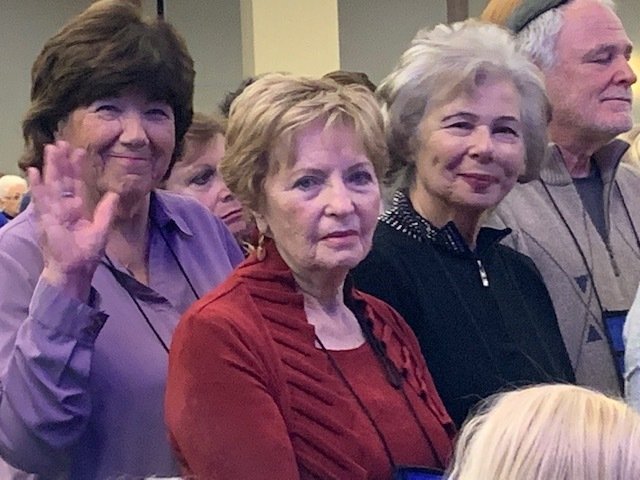
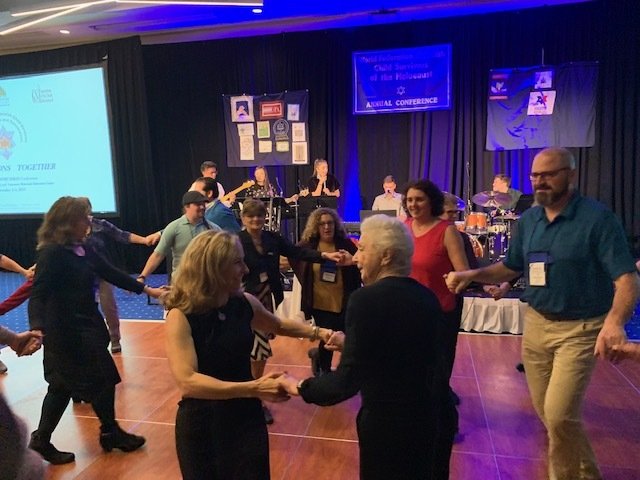
Nearly 400 Survivor Generations: Child Survivors, members of the Second and Third Generations, gathered together in sunny and chilly Vancouver. Together with the Vancouver Holocaust Centre, a memorable program was designed. Workshops, speakers and panel discussions were engaging, emotional and educational, and a wonderful community was created over the three days.
Nearly 400 Survivor Generations: Child Survivors, members of the Second and Third Generations, gathered together in sunny and chilly Vancouver. Together with the Vancouver Holocaust Centre, a memorable program was designed. Workshops, speakers and panel discussions were engaging, emotional and educational, and a wonderful community was created over the three days. (click to see conference photographs)
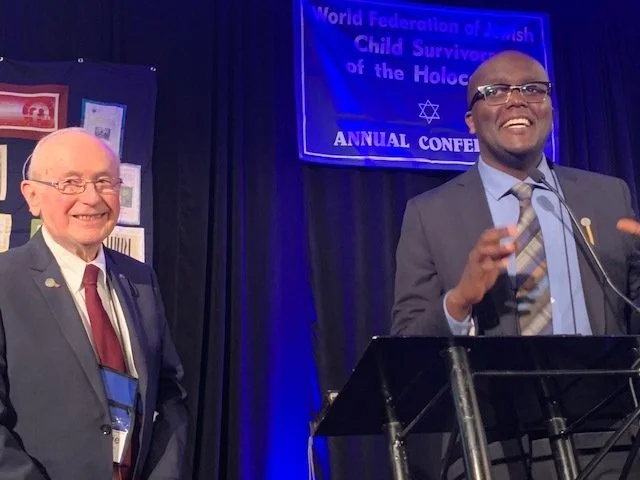
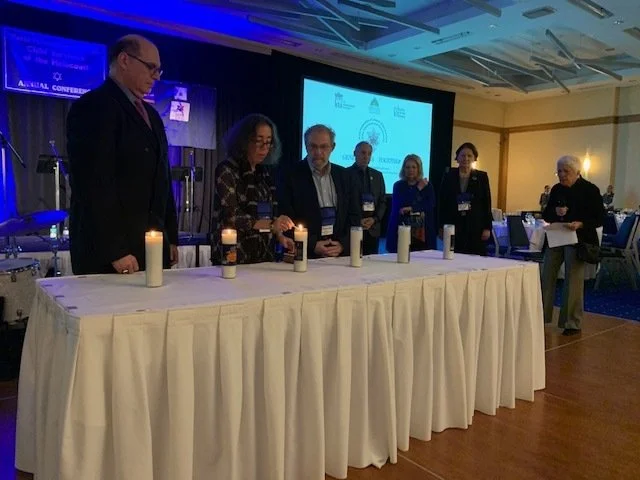
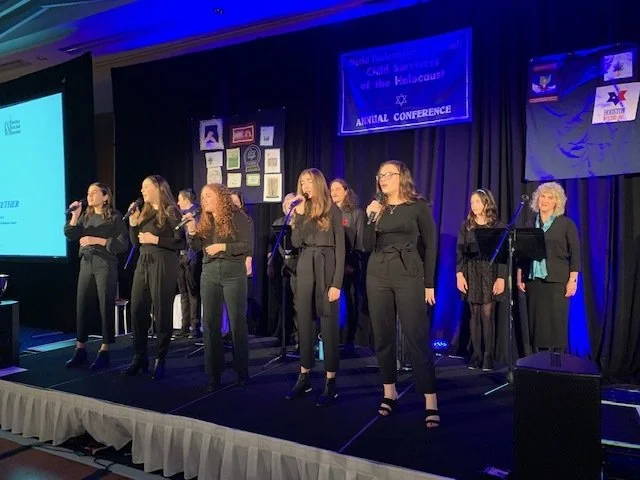
2019 Conference, Vancouver. Historians and Survivors as Partners in Telling the truth of the Shoah, Chris Friedrichs
HISTORIANS AND SURVIVORS AS PARTNERS IN TELLING THE TRUTH OF THE SHOAH Chris Friedrichs Professor Emeritus of History University of British Columbia World Federation of Jewish Child Survivors of the Holocaust and Descendants conference November 2019 Note: You may quote or cite this lecture, but please do not publish or circulate the full text
HISTORIANS AND SURVIVORS AS PARTNERS IN TELLING THE TRUTH OF THE SHOAH
Chris Friedrichs Professor Emeritus of History University of British Columbia
World Federation of Jewish Child Survivors of the Holocaust and Descendants conference November 2019
Note: You may quote or cite this lecture, but please do not publish or circulate the full text without permission. Thank you.
This is a gathering of men and women bound by a common identity. All of you are child survivors of the Shoah, or children or grandchildren of child survivors. Since identity is so central to this event, let me begin by saying a few words about my own identity.
I am not a child survivor or the child of a child survivor. My parents were refugees to the United States from Nazi Germany. My non-Jewish father and my Jewish mother were engaged but not permitted to marry because the notorious Nazi Nuremberg laws made it a crime for Jews and non-Jews to marry. So they escaped to the United States where they married and had five children. I myself was born shortly after the war ended, always knowing, of course, that many members of my mother’s family had not been so fortunate as she was and had been murdered by the Nazis.
But I also have another identity. I am a historian. My research has mostly concerned earlier periods of German history – but no historian of Germany, and certainly none with a personal history like mine, could fail to feel a profound interest in the Holocaust. Thinking and speaking about it has been an important part of my career. What I say and teach about the Shoah has been informed by many sources of information – but above all by the research of other professional historians, and by the narratives of Holocaust survivors. So what I want to talk about today is the role played by these two important groups in telling the truth of the Shoah.
It is important to realize the first research into the history of the Shoah began to take place even before it actually had ended. In the fall of 1944 – months before Auschwitz and other camps were liberated but when the Soviet army had gotten control of eastern Poland – a small group of Jewish survivors, most of whom had been historians before the war, decided that they must immediately start gathering material about what had happened to the Jews. Consider the situation: the war was still raging, there were shortages of food and of places to live, many of these Jews knew or feared that most of their relatives had been killed – but even so, they got to work. They founded what they called the Central Jewish Historical Commission and spread the word that every surviving Jew in Poland should compose and send them a full account of what they had experienced. These survivor historians were concerned that if this were not done, others would propagate a false history of the war claiming that the Germans had not done any harm to the Jews. Within a few months, this commission had a formal structure and a director was chosen. His name was Philip Friedmann. All the other members of his family had been murdered – but with the incredible resilience that was so typical of many survivors, he poured his energy into this new project. Questionnaires were distributed to as many surviving Jews as could be located. The commission was particularly interested in hearing from child survivors, because they believed that these children would provide the most objective accounts of what they had seen or experienced, uninfluenced by prejudices or ideological factors or conversations with fellow-survivors. A huge amount of material was gathered.
But this material was then ignored. As the communists gained increasing control over Poland, they showed little interest in these activities. Many of the Jews in Poland were made to feel unwelcome, and most of these historians left to go to western Europe or the United States or Palestine. Their work remained unread in storage boxes for decades.
And indeed, in the first fifteen years after the war ended, little was said or written about what we now call the Holocaust or the Shoah. There was lots of interest in the history of the war, of course – books about battles or military campaigns or biographies of generals became best sellers. Nobody really forgot about what happened to the Jews, but this was often just seen as one small part of a big story of massive military activity that inflicted suffering on many different groups of civilians. And the survivors themselves were often preoccupied with struggling to establish new lives for themselves, whether in Europe or North America or Israel. Often they just wanted to look forward, not back to the past.
There were some exceptions, of course. When Anne Frank’s diary was given to her father, he was determined to get it published. And it was – first in Dutch, then in English and countless other languages. It became an international best seller – and rightly so. Every reader of the diary – and surely that includes almost everyone in this room – can relate to the story of this gifted teenager struggling to cope with the claustrophobic life of the secret annex. And every reader knows how Anne’s life ended – not with the return to normal life in Amsterdam for which Anne desperately yearned, but with the betrayal, the arrest, the deportation to Auschwitz, and ultimately her ghastly death from typhus and starvation in the mud of Bergen-Belsen.
A few other books about what Jews had experienced also appeared. One was written by a young survivor of Auschwitz and Buchenwald named Elie Wiesel. After his liberation from Buchenwald at the age of 16, Wiesel was taken to France and eventually became a journalist there. In 1955 he wrote an enormous book in Yiddish about what he had experienced. Almost nobody read this. He then rewrote this into a short book in French. A few people read this. The book was then translated into English. One publisher after another rejected the manuscript until finally one agreed to print a few thousand. Unlike the diary of Anne Frank, few people read this book at the time—it was just too depressing. It took decades before Night became widely known, one of those books everyone should read.
Night is a memoir. But it is not a work of reportage. Because it was a condensed version of the original 800-page version, some experiences were combined or reshaped for brevity. But what it retained was absolute emotional truth. Even if some events did not happen exactly when and where Wiesel said they did, every line of the book reflects the authentically and often deep conflicted emotions that this teenager experienced as he struggled to remain close to his increasingly desperate and helpless father while also urgently hoping to survive. His father, of course, did not survive. But he did.
Meanwhile a very different kind of book was being written. Raul Hilberg was the son of Austrian Jewish refugees who had escaped from the Nazis and arrived in New York in September 1939. He studied history and political science, started teaching at a small university in Vermont, and dedicated himself to doing something that nobody had yet undertaken: to write a complete, meticulous history of the relentlessly well organized and systematic way in which the German regime had destroyed the lives of five to six million Jews during the Second World War.
Hilberg’s book was not about the victims, it was about the perpetrators. Indeed, the first paragraph of the preface made this completely clear: “This is not a book about the Jews. It is about the people who destroyed the Jews.” The book was based on a study of thousands of German documents. Pages are devoted to things like railway lines or organizational charts or analyses of the supply chain for obtaining the gas for the gas chambers. When Jews are described, it is mostly in connection with how they were coerced into helping the Germans operate the ghettoes or why they could not resist the German orders.
There were two main reasons for this. In the first place, Hilberg belonged to a generation of historians who had been taught that the best way to understand the past was to study documents – and the Germans had produced incredibly many documents. At the same time, Hilberg also belonged to a generation of political scientists who believed that the most important question of their time was to figure out how the great totalitarian regimes in Germany and the Soviet Union and the militaristic regime in Japan had come to power and, having done so, why and how these regimes inflicted so much suffering on so many people. The suffering itself was not so important to describe. It was taken for granted. People of that generation remembered the war, after all.
This book, published in 1961, was a turning point in understanding what we now call the Holocaust.
So was another event which took place in the same year: the trial of Adolf Eichmann. As you know, Eichmann was the SS official in charge of the vast operation by which millions of Jews were transferred from the occupied countries of Europe to the Nazi death camps. His capture in Argentina by Israeli agents and his trial in Jerusalem attracted world- wide interest. It was largely as a result of this trial that more and more people began to understand that the killing of Jews was not just a part of World War II, it was a distinct event in and of itself that took place during and under cover of the war – an event to which people gradually attached the name Holocaust. And there was ever more interest in learning about this distinct event.
So more and more aspects of the Holocaust were researched. More and more books were published by historians and social scientists. The Holocaust emerged as a distinct sub-discipline of academic study.
But something else started happening too. More and more survivors started telling or writing their stories. Of course survivor testimony was not new. Even though the records gathered by the Polish commission were sitting unnoticed in storage boxes, other accounts given by survivors got more attention. Some survivors had testified at the Nuremberg trials or at trials of SS commandants. Survivors gave testimony at the Eichmann trial. These accounts were widely reported.
But that was only one of the many ways in which the voices of survivors came to be heard. Many survivors were now more willing to come forth and tell their stories to their children, to their friends, or to groups in their home communities. And more and more people were willing or even eager to listen. That included professional historians. A new generation of historians was increasingly interested in studying not just the actions and decisions of the people who guided the destiny of nations; there was more and more interest in what was called history-from-below – the lived experience of men and women and children. And this meant that in studying and teaching about the Holocaust, the experiences of victims and survivors came to be heard and read and recorded. This was also the time when the first Holocaust education programs were established and survivors were called upon to tell their stories.
You – the child survivors – were part of that process. You increasingly spoke out. Take a look at this list. Not many of you, I think, have been called upon to give testimony in courts. But every one of you has told your story in at least one of these forms and often in many more. In many cases you have told your story to many different kinds of audiences. And often the most important audiences to whom you have spoken have been young people.
Here in Vancouver a program of teaching high school students about the Holocaust was launched over forty years ago. By now tens of thousands of students from all over southern British Columbia have attended these events, sometimes in their own schools, sometimes on the campus of my university. Usually such a program begins with a historian explaining to the students what the Holocaust was and why it is important to learn about it. But the highlight is always when a survivor of the Holocaust then comes forward to tell his or her story. I have participated in dozens of these events as the historian on call, and I have always been moved to see how students of every race or color or ethnic background react to hearing an actual survivor describe what it was like to live in a ghetto or to be at Auschwitz or Buchenwald or to spend years as a frightened child, hidden in an orphanage or living with a family of rescuers but always knowing that one must rush to hide in a closet or in the cellar whenever a stranger visited, and never knowing when or how one would see one’s own family again. I could see how moved the students were, and the letters they wrote afterwards reinforced the point. Most of these students would never read any of the thousands of academic studies of the Holocaust, and nobody would expect them to. But to hear a survivor talk could change their lives.
In recent years, of course, simply because of the inevitable passage of time, more and more of the survivor speakers in Vancouver and elsewhere have been child survivors. Many of our local child survivor speakers are right here today. They – and all of you who contribute in a similar way to your own communities – are doing an invaluable service.
But survivor narratives in their various forms are not only vital for education. They are also increasingly appreciated by historians as indispensable sources of information and inspiration for understanding dimensions of the Holocaust.
Of course there are still historians who prefer to work only in archives with documents generated by the perpetrators and their allies or collaborators all over Europe. Some of them might even say that such documents are more reliable than survivor narratives. Survivors, after all, were not taking notes. People hiding in cellars or working in slave labor factories or starving in camps could hardly be expected to keep any records. They might misremember exactly when and where something happened or which brutal uniformed guard had said or done this or that. Documents are more reliable.
Well, yes and no. Documents, after all, can lie. And they often do. Let me give you just one example. This particular document has a deeply personal meaning to me. It is located today in an archive in Berlin. It comes from a file of records having to do with the confiscation of property owned by an elderly Jewish couple in Berlin shortly before they were deported to their deaths in 1942. These two people, Thekla Rosenberg and Carl Rosenberg, were in fact the grandparents of my late wife.
These documents exist because two different German agencies were engaged in a dispute about which agency was entitled to claim the money which had been stolen from the Rosenbergs before they were put onto trains headed to Poland. In referring to those deportations, the document says “when they were sent to the east to be resettled.” But Carl and Thekla Rosenberg were not sent to the east to be resettled, of course. They were sent to the east to be murdered. Any good historian, of course, knows exactly what this coded language means. But it is a reminder that documents do not simply speak for themselves. Everything must be studied, compared, contextualized, interpreted.
And of course the same applies to the way in which historians use and interpret survivor narratives. Among the tens of thousands of survivor narratives that have come to light, a handful – half a dozen or so – have proved to be falsifications. They were written by some deeply troubled souls who were not survivors at all but for some strange psychological reasons wished they were. We need not dwell on these odd cases. What is more important is that many, perhaps even most, authentic survivor narratives do have some discrepancies or omissions. Sometimes survivors have some memory that is simply so agonizingly painful that they cannot bear to put it into words. Sometimes survivors have confused a date or mixed up a name or forgotten the exact order in which some things happened. But almost every survivor narrative is completely reliable when it comes to the most important element of all – emotional truth. For no matter how difficult it is to recall a name or a date, survivors never forget what they saw and how they felt.
Many of you have written descriptions of your own experiences, and some of you have composed or even published an entire memoir or autobiography. Often the title of such a work contains some reference to memory: “Memories of My Youth” or “What I Remember.” For after all, a memoir or autobiography is in fact a collection of organized memories. I will mention only one example. It is the recent autobiography of someone who is well known to every one of you and to me as well – my esteemed friend Dr. Robert Krell. It is a book I can well recommend reading – but at the moment I just want you to take a look at the title: it is not ‘Memoirs,’ and not ‘Memories’ – but instead it is called ‘Memoiries.’ It is a word that encapsulates exactly what all memoirs really are – a collection of memories.
But how can professional historians use such memoirs – such ‘memoiries’ – in constructing an ever deeper or richer understanding of what happened in the Shoah? Are such writings – your writings, in many cases – reliable enough to be used in compiling the historical record? Let me discuss the work of one historian who has set out to answer exactly this question.
Professor Christopher Browning is one of the most famous and admired of all Holocaust historians – and rightly so. For most of his career, Browning focused chiefly on the perpetrators, with pioneering studies of the step-by-step process by which the Holocaust was initiated and equally important work on the behavior and mentality of ordinary guards and SS members who carried out these operations.
But then Browning became increasingly interested in the experience of survivors, and especially the way that survivor testimonies can add to our understanding of the Shoah. He came across the interesting case of a cluster of camps in a town in central Poland called Starachowice, where Jews lived while doing slave labor in a nearby steel mill and munitions factory run by the Germans. For two years they were kept there, until in 1944 all the inmates were transferred to Auschwitz. Because it was expected that they would continue to work together as a team, these Jews were kept together in a separate barracks and surprisingly many of them were still alive when Auschwitz was liberated a few months later. As a result, there are remarkably many survivor testimonies from this particular group – Browning found interviews and narratives and memoirs by almost three hundred survivors who had been at that labor camp and then in the barracks in Auschwitz. This made possible a unique project – comparing exactly how different survivors described the same events and experiences.
And what did Browning find? He found that overwhelmingly their stories matched. Of course the accounts were not identical. The remembered different things, or remembered the same episodes differently. But the basic story was always the same. And in fact by comparing and collating the different versions of each important episode in the camps and the factories and Auschwitz, Browning could arrive at the most detailed and convincing version of what had happened to these Jews.
There were some discrepancies. For example, almost all the survivors described vividly how, after days trapped in a train without food or water, they finally arrival at Auschwitz. They all told of the same things – the darkness, the bright searchlights, the barking dogs, the shouting uniformed SS guards. But many also mentioned seeing the notorious Dr. Mengele as they came down the ramp. That, in fact, did not happen; Mengele was not there that evening. But in the years since 1944, the survivors had read and heard so often about Dr. Mengele and his selections that they assumed he must have been one of the uniformed men they saw. This was a rare instance of incorrect memory. But in fact the overall result of Browning’s book is to demonstrate beyond any possible doubt that survivor testimony is not only useful but in fact an indispensable source of information for historians who are still struggling, seventy years later, to fully comprehend what happened in the Shoah.
So historians are still telling the story of the Shoah. And so are survivors. But why?
To tell of these things goes far beyond the normal human impulse to recount stories from the past. For we must keep teaching people – above all the younger generation – about what can happen when racist thinking takes over a society and becomes the basis for an entire program of state-sponsored genocide.
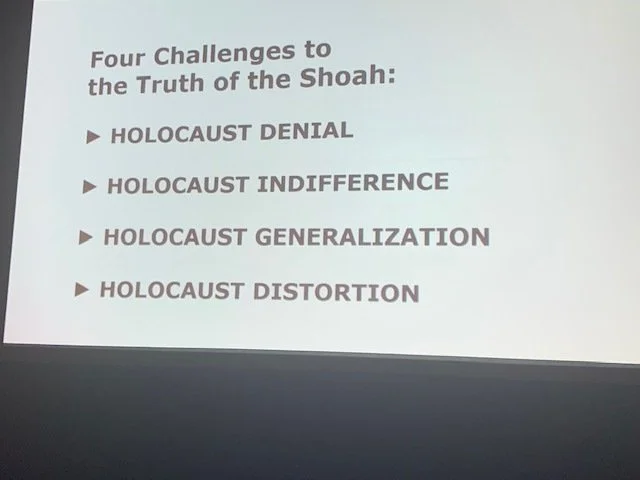
And we must combat the dangerous attitudes that threaten to diminish the importance of these lessons. Here are what, in my view, are the four greatest challenges to the truth about the Shoah against which we must always struggle.
We all know about HOLOCAUST DENIAL. And we know that the main cause of Holocaust denial is of course antisemitism, pure and simple. But that is not the only cause. Some of the Holocaust deniers are
motivated by something else. They are contrarians, people who enjoy cooking up or believing conspiracy theories for their own sake. They are nurtured by the garbage produced by the antisemitic Holocaust deniers, and their own conspiracy theories in turn further nurture the antisemites. It is a problem that will not go away. But it is not, in fact, the biggest challenge.
That is HOLOCAUST INDIFFERENCE. Most people, after all, fully accept and understand that the Holocaust took place. But “so what?,” they say. “Lots of bad things happened in history. Why keep harping on this one? Let’s just look ahead and build a better future.” But in fact the most important building blocks for a better future are a knowledge of the past. History does not slavishly repeat itself — but there are patterns. And if we do not know what the patterns in the past were, we will not recognize them in time when they come back.
And there is HOLOCAUST GENERALIZATION. “Sure, the Holocaust was genocide. But genocides are happening all over. The Holocaust was just one of a long list.” Yes, many terrible things happen to people and they must be discussed. But true genocides are much rarer, and the term should be used carefully so that it does not lose its meaning. We must always remind people of the truly horrific genocides of the past hundred years. We should not forget the Holodomor, Stalin’s mass murder of millions of Ukrainian peasants by the brutally simple method of having his agents confiscate every last bushel of grain so the peasants had nothing to live on. Nor should the events in Armenia, in Cambodia, in Rwanda, in Darfur be forgotten. But nor should the fact that even on this horrific list, the Shoah was unique in the relentlessness with which a powerful state regime tried to eliminate from human existence an entire age-old human community.
Finally, there is HOLOCAUST DISTORTION. This take place when people fully agree that the Holocaust took place, but do so in a way that so completely distorts its meaning that it perverts the actual truth. Time permits me to mention only one example, and that only one briefly: some recent events in Poland. Many of you will remember being shocked about the Polish legislation that was enacted last year which made it a criminal offense to state that the Polish state or nation was responsible or co-responsible for the Nazi crimes of World War II. After an international outcry, the law was amended to eliminate the criminal penalties, but the amended law is still on the books. Its real purpose is to make people in Poland nervous about discussing this sensitive aspect of their country’s history – something which, by the way, many courageous Polish historians continue to do despite the consequences. But this law had nothing to do with Holocaust denial. Quite the contrary. The fact that millions of Jews had lived in Poland before the war and that three million of them were murdered – along with many non-Jewish Poles – is a fact that the Polish government actually encourages people to remember. The government itself produces books and sponsors exhibits about this subject. And the reason is this:
Thousands of Poles courageously and at great risk to themselves and their families rescued or sheltered or helped Jews. They are honored at Yad Vashem as the Righteous Among the Gentiles, and rightly so. They are honored in Poland too. In fact they are venerated as Polish national heroes for having defied the Germans in this way. If you deny that the Holocaust happened, then all these rescuers would have to be denied as well.
What many groups in Poland wish to forget is the fact that while there were thousands of Poles who rescued Jews, there were many, many more who did the opposite. Poles did not cause or initiate the Holocaust. But once the Germans arrived, there were many people who saw in this an opportunity to get rid of Jews or to take their property. Of course much the same happened in almost every country the Germans occupied, except perhaps Denmark and Albania. But since there were so many Jews in Poland, it happened there with particular frequency. In July of 1941, in the town of Jedwabne, before the Germans even began the round- up of Jews local inhabitants themselves rounded up hundreds of Jews, locked them inside a barn, and set the barn on fire. And this case was not unique. Historians can show that in numerous Polish communities when the Germans did indeed order all the Jews to assemble to be deported to camps, many of their neighbors immediately started plundering Jewish homes or even grabbing the meager possessions the Jews were carrying with them on the way to the stations. These facts must be confronted and remembered. Many Polish historians and researchers and curators are doing exactly that. But legislation of the kind passed last year, even in its amended form, could make many more people hesitate to speak out.
This makes it all the more important in countries that enjoy freedom of speech to use that freedom fully to keep on telling the truth about the past – and especially about the Shoah. My job – and that of countless other historians – is certainly not finished. And neither is yours.
Let me close by mentioning two specific women here in Canada. One was Bronia Sonnenschein. Members of the audience from Vancouver will remember Bronia well. She was not a child survivor. She was already a young woman when her family had to leave Vienna and live in the Lodz ghetto. From there they were taken to Auschwitz and then, in the closing days of the war, Bronia and her mother and sister were sent on death marches first to Germany and then to Bohemia where they were finally liberated. Eventually Bronia came to Vancouver where she raised a family and worked hard until she retired. At that point she began speaking in public about the Holocaust, especially to high school students. Time and time again I saw hundreds of our local students sit in awed silence as this tiny woman with a strong European accent described, without pathos or bitterness but with uncompromising honesty, everything that she had experienced in those horrific years. When she finished speaking, the students jumped to their feet in a standing ovation and as soon as the program ended they rushed down to meet her, to thank her, to embrace her. She had changed their lives.
Bronia retired from public speaking at the age of 92 and died three years later. But her legacy lives on. A few years ago her granddaughter Emily wrote a play based on her grandmother’s life. The play was performed with great success in Emily’s home town of Calgary, Alberta. It has also been performed in Germany, and surely more performances lie ahead. Through her own granddaughter, Bronia’s message lives on.
All of you who are child survivors have told your stories, perhaps in front of hundreds of students, perhaps to individual interviewers or researchers, perhaps in the form of a book or a manuscript, perhaps around the kitchen table to your family or friends. The time will come when you too feel that you can retire from telling your stories. You can do so knowing that your story will not be forgotten.
One reason it will not be forgotten is that many of you have children or grandchildren or nieces or nephews or just friends of a younger generation who will carry the message forward. To those of the next generations, let me say this: Don’t worry, you do not have to write a play – but when you are asked to tell the story of your mother or father or grandparent or uncle or aunt, do so. You cannot hope to have the same emotional impact as actual survivors, but what you say will have the ring of truth and it will matter to those you reach.
And we historians will back you up. Because in fact historians on the one hand and survivors and their descendants on the other have always been partners in telling the truth about the Holocaust. And as long as the world is willing to listen, we will continue to tell about the events and the significance and the implications of this unspeakable episode in the history of humanity. Together we will continue to tell the truth of the Shoah.
WFJCSH&D conference in West Palm Beach, Florida, 9- 12 November 2018
Again we have participated in a wonderful conference, this time at Florida’s east coast. The weather was great and we stayed in the nice Marriot West Palm Beach hotel, where we could sit and schmooze in a spacious lobby, a wonderful garden and relax and swim in the pool.
Again we have participated in a wonderful conference, this time at Florida’s east coast.
The weather was great and we stayed in the nice Marriot West Palm Beach hotel, where we could sit and schmooze in a spacious lobby, a wonderful garden and relax and swim in the pool.
The organisers had selected for us many interesting workshops and panel discussions so that sometimes it was very difficult to choose where to go.
The opening evening started with the commemoration of Kristallnacht; now 80 years ago. Melissa Hacker , President of the Kindertransport Association, referred in her speech to the connection between the pogrom of November 9, 1938 and the Kindertransport, and Max Arpels Lezer, Vice-President of the WF, spoke about Kristallnacht from a very personal point of view. Two moving speeches that brought tears to people's eyes.
After the breakfasts and after lunches we had the opportunity to listen to very interesting key-note speakers.
The speech of Dr. Robert Krell was so moving that your reporter noticed that several people had tears in their eyes.
But also the speeches of Dr. Anna Rosner, Ira Forman and Dr. Alan Berger were very interesting. We heard their opinions about anti-Semitism, where it comes from and how to fight this. How this touches our day to day life and how much we worry about it.
Dr. Berger talked about “Proximity and distance”: the third generation. For the next generations a very interesting topic.
The World Federation should be proud that almost 400 people attended this conference.
When looking at the statistics we noted that out of the nearly 400 attendees 366 persons had a USA passport, 15 persons came from Canada, 3 from Australia, 2 from Ecuador and 2 from France. 4 people came from Israel and 4 from The Netherlands, and we spoke with 1 attendee who came from Poland.
bFor years we now we have noticed a decline in Survivors coming to these conferences, that is of course for obvious reasons. However the conference does not see a decline in the total number of attendees.
That is because the 2nd and 3rd generations also take a great interest in coming to the conferences, they are interested in interaction between the survivors and themselves. There are also workshops and panels especially focussed on their issues.
We have seen 117 attendees of the 1st generation and 216 of the 2nd plus 3rd generation.
Beside the survivors and their descendants we have seen 40 spouses and 24 Kindertransport survivors and descendants.
Your reporter attended a very nice and open conference, with a wonderful and friendly atmosphere, well organised and much room for interaction between survivors and descendants.
The conference committee including theconference coordinator Susan Dubin of the WFJCSH&D deserves a big and well deserved compliment.
When writing this small report it is unknown where next years conference will be held but wherever we will meet again, hopefully the food will be better.
by: Max Arpels Lezer
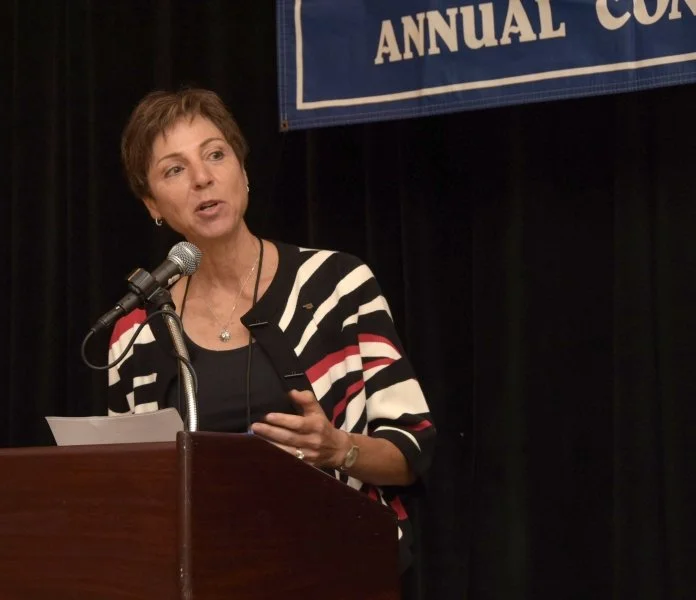
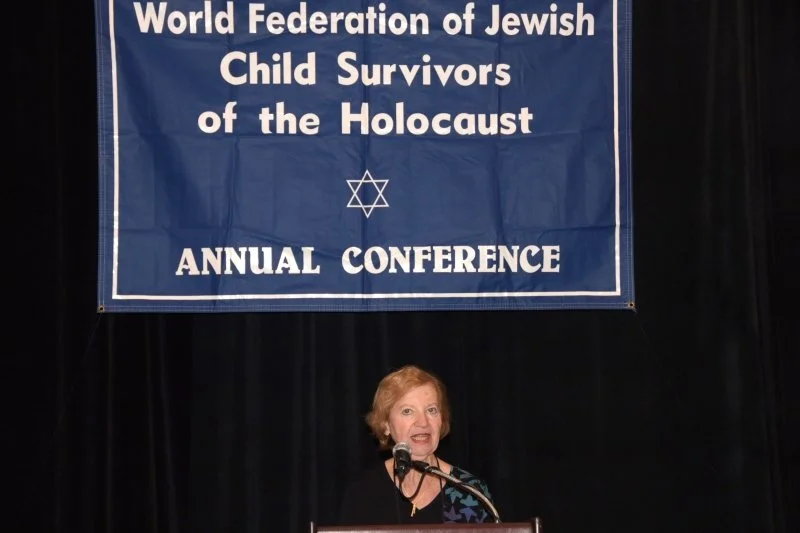
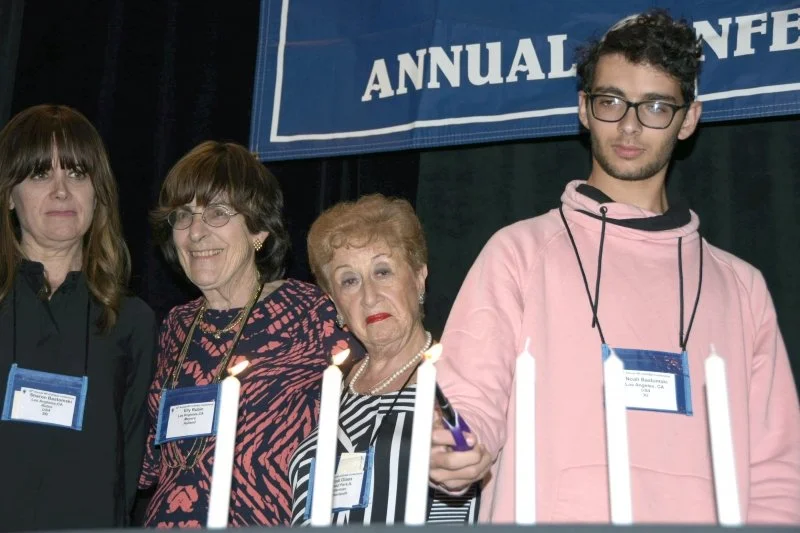
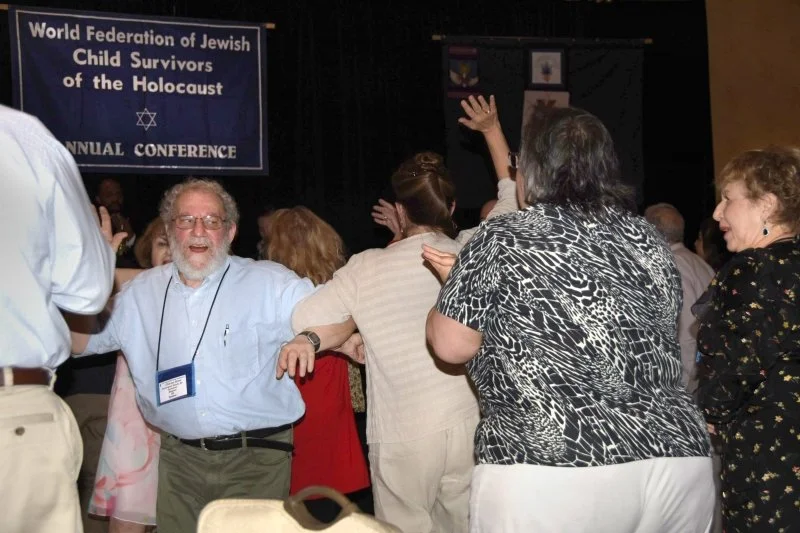
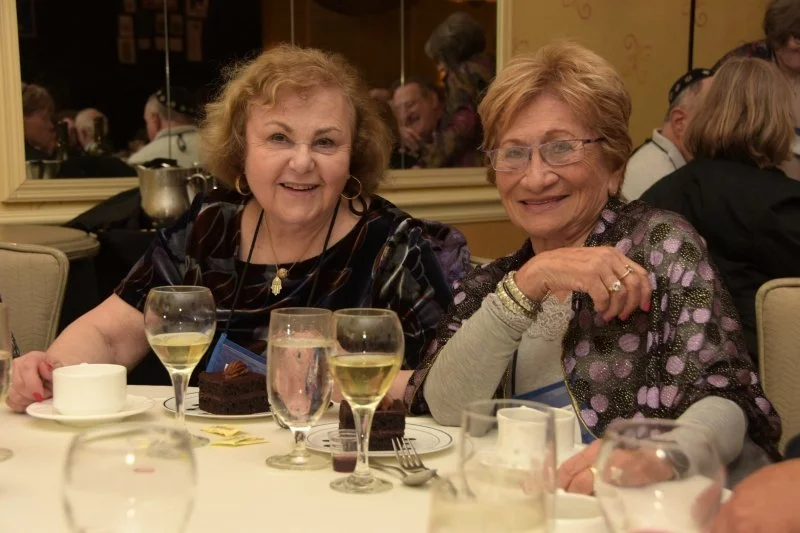
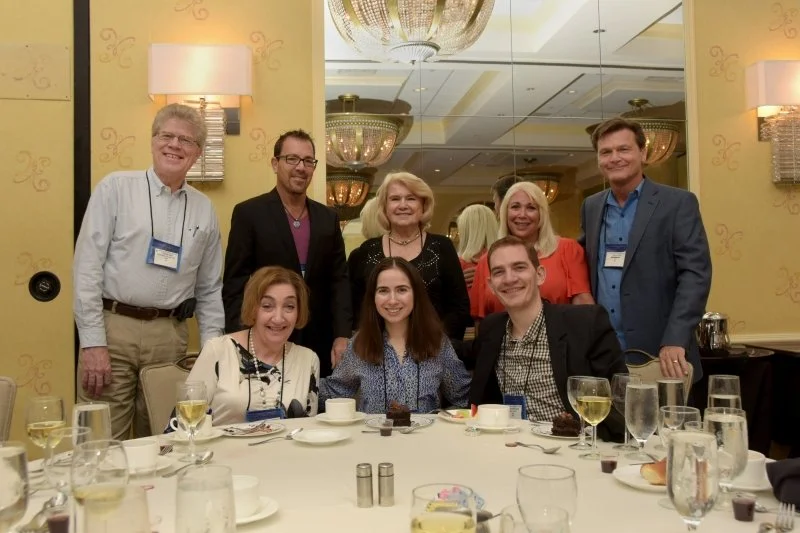
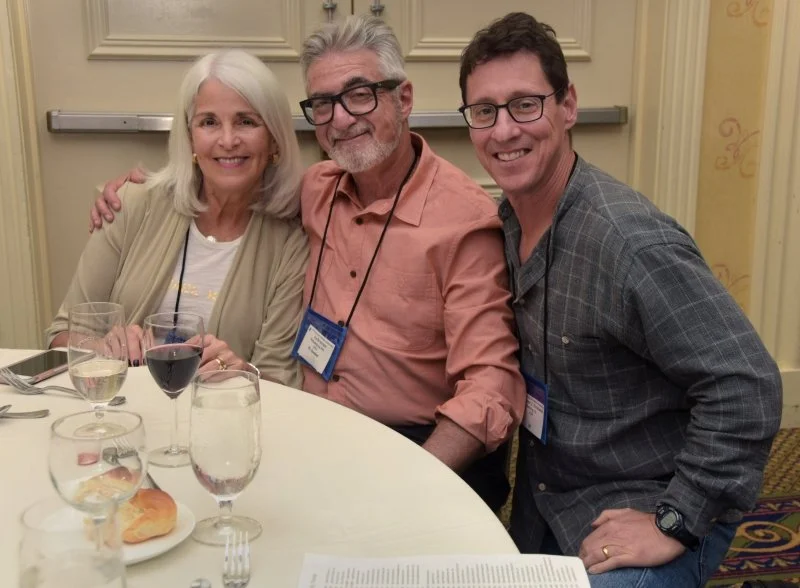
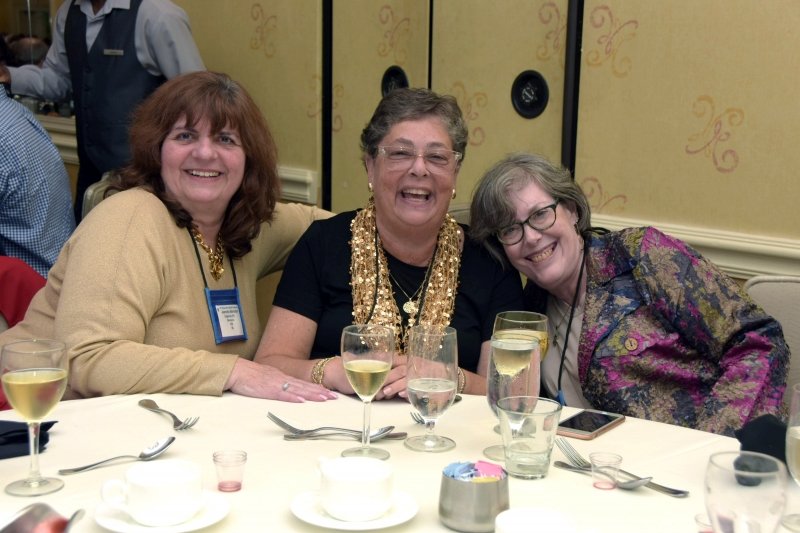
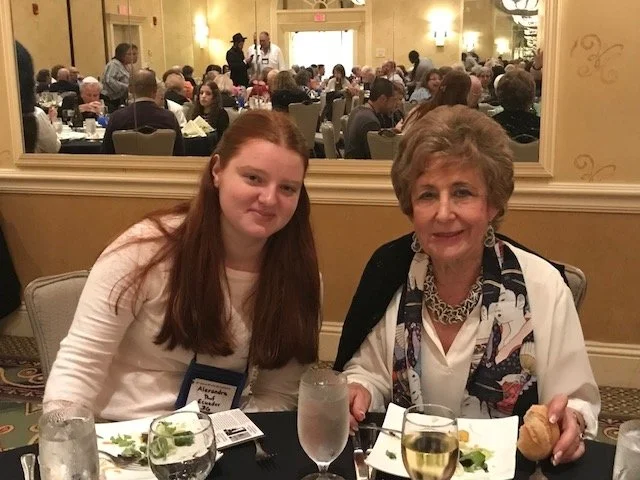
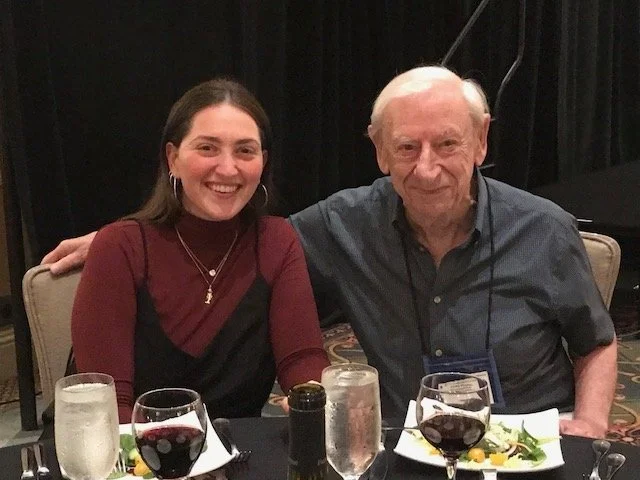
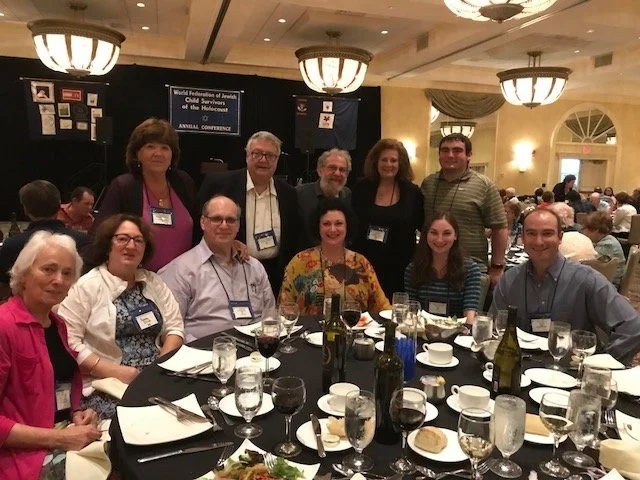
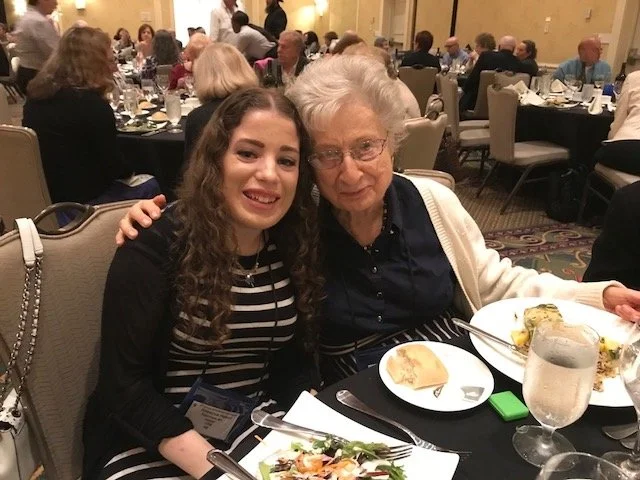
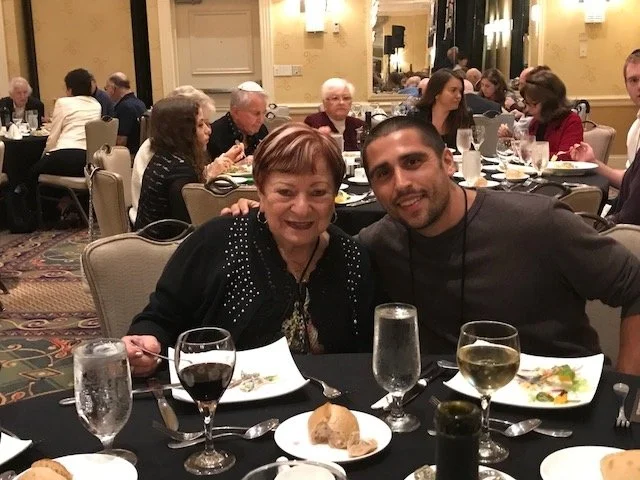
2018 Conference, West Palm Beach, How to Succeed at Succession, Robert Krell speech
Dear Friends, It is precisely 80 years since the Reich’s Kristallnacht Pogrom of November 9 & 10, 1938. We must take note of that precise moment when the Shoah began in its most lethal form. Of course, German propaganda and its virulent anti-Semitism had been evident for many years and Jewish civil rights had been…
Dear Friends,
It is precisely 80 years since the Reich’s Kristallnacht Pogrom of November 9 & 10, 1938.
We must take note of that precise moment when the Shoah began in its most lethal form. Of course, German propaganda and its virulent anti-Semitism had been evident for many years and Jewish civil rights had been seriously compromised from the first minute in 1933, that the Nazis achieved power through a democratic “election”. Somehow Jews were stuck with a false sense of security. And even with the Nuremberg Laws, the total destruction of Jewish civil and professional rights in Germany, it had yet to sink in that preparations for the elimination of German Jews had begun.
It was the Reich’s Kristallnacht, the organized burning of Synagogues, the sanctioned murders of Jews in the street, the destruction of Jewish businesses throughout the country, and the massive imprisonment of captured Jews incarcerated in the concentration camps of that time, all in Germany, that signaled the Shoah had begun in full force.
So let us today, as we talk and learn together, give pause to the memory of those monstrous times and also teach our children and grandchildren, from our experiences, to recognize and defeat any signs that signal a repetition.
Watchful paranoia can be helpful.
Yet while remembering those tragic times, we must nevertheless also indulge in celebration of the fact that we are here together for a Gathering, over 30 years after our defining moment – the discovery of us – the children who survived. Let me remind you and our children and grandchildren that we had disappeared for a time, from approximately 1945 – 1985.
One day in Jerusalem, at the World Gathering of Jewish Holocaust Survivors in 1981, everything changed for me.
I had come to the Gathering for many reasons, one very important – the honouring at Yad Vashem of my rescuers, Albert, Violette and Nora Munnik. All three had previously been inscribed Among the Righteous. My dear “Vader” had passed away. But Moeder and my sister Nora were with me in 1981 to plant a tree and to be properly recognized – in Jerusalem.
My parents, Leo and Emmy Krell, who had miraculously survived the war were there, as was my brother, born in Canada in 1956 and fifteen years younger than I, accompanied by his wife.
At one point during the ceremony in the Hall of Remembrance, I looked up during the chanting of El Malei Rachamim and through my tears saw Moeder at my side and my mother standing at the railing opposite. Two mothers – one who gave me into hiding at age two to save my life, the other who accepted me, and thereby did save my life.
One of the opening speeches at the Gathering caught my attention. I am not good at listening to speeches. I drift away.
But then I heard, “My name is Israel Meir Lau, and I am the Chief Rabbi of Netanya. My father, the Rabbi of Piotrowsk was murdered at Treblinka, my mother died of hunger at Ravensbrück. I was the youngest survivor of Buchenwald. I was eight years old.”
It was as if lightning had struck. Rabbi Lau was eight-year old Lulek at liberation! The rabbi had my attention. After all, in 1945 my first cousin Nallie was six, my second cousin Milly eight, and I was five. We were the children who survived the Holocaust, child survivors of the Shoah.
So that is what I discovered. And of course, it is likely that other children somewhere had made a similar discovery but I had not heard of them nor seen any identify themselves as child Holocaust survivors.
The adult survivors were solidly rooted in their identity as Holocaust survivors and of course had been the dynamic force behind the 1981 World Gathering, including such leaders as Ben and Vladka Meed, Ernst Michel, Eli Zborowski, and Dr. Hadassah and Josef Rosensaft amongst others.
And the Second Generation had announced itself with conferences and gatherings in the late 1970’s which also saw the publication of Helen Epstein’s ground breaking book Children of the Holocaust: Conversations with the Sons and Daughters of Survivors. Therefore, the adult survivors had found an identity, as had the Second Generation.
But where were we, the children? Most of us had been in hiding. Very few little ones survived concentration camps, making Rabbi Lau, at age eight, a very rare exception. Of the 1,000 children found at Buchenwald, most were adolescents aged twelve or thirteen and older.
At Ećouis, where 426 of the children were taken by the OSE French Rescue Society, the staff had prepared little beds but they received few little ones.
And these children sent there for their recovery were told many things, some insulting and derogatory. Apparently a psychiatrist or psychologist told the gathered assembly of children that they would never recover and by other doctors that they might not live long, and by officials that they were probably sociopaths. (Who but sociopaths could possibly have survived? Or so they thought). I have been told this by several boys who were there.
But they were also instructed despite the various dire and ominous predictions, to leave the past behind and get on with the future. Fortunately, they had some wonderful and optimistic social workers like Judith Hemmendinger and her assistant Niny Cohen, and teachers like Manfred Reingwitz who tamed them, nurtured them, and salvaged most of them. These camp children included Elie Wiesel, Israel Meir Lau and his brother, Naphtali Lau-Lavie.
What had happened to children saved in hiding? I know of some early interviews of children in the post-war years. Indeed, there were photos in LIFE magazine of some who arrived to America. And many were spirited out of Europe to Israel, then still the British Mandate of Palestine.
Forty-eight such children arrived to Vancouver, Canada as early as 1947. I have talked with many over the years.
What did children in Canada or the United States or Australia or in Israel do? They remained hidden. Hiding was difficult during the war, much easier after. The few who tried to talk did so at great personal risk. They did not wish to reveal themselves as different; as having coped with monstrous experiences, enormous losses, and monumental insecurity. We wanted to look and to be normal.
In any case, few adults, even mental health professionals, especially mental health professionals, did not ask about their experiences and advised them to forget the unforgettable. And worse, children were told that because of their young age, they likely had no memories and therefore, did not suffer.
Before the war, a single childhood trauma was viewed with great alarm and resulted in years of psychoanalysis and psychotherapy but this obvious massive psychological disaster was virtually ignored. Perhaps no one knew what to do with us. We had been immersed in death. 93% of all Jewish children under Nazi domination were murdered.
My memory starts just after my second birthday. The Krells received orders to report on August 19, 1942 at a place from which Jews were sent to Westerbork and onwards to unknown destinations “for resettlement to the east.” The names were unknown to Dutch Jews then, but were later revealed to be Auschwitz or Sobibór.
We fled the house and my memory kicks in. Placed with former neighbours, I remember getting rides on the shoulders of Peter (Pietje), a teenager in the household. Soon after, I was placed with the Munniks when my Moeder came on a visit to these neighbours who were friends of hers. She spotted me, asked about me, and when told that I needed a place to hide, took me home with her. I became Robbie Munnik.
My new sister Nora, who was ten years older, came home after school and played with me, teaching me to read and write. Of course, I had been forbidden to look out the front window for fear of being spotted by Dutch Nazi traitors. I had a mop of curly black hair and I was living in a family of blondes.
As good a sister as Nora was, she almost had all of us killed. She took me out in a buggy. When I asked Nora about the buggy ride, (some thirty years later), an outing so unusual for me that I remember it clearly, she told me that it never happened. Assuming her memory to be far superior to mine at age thirteen or fourteen to my age three or four, I let it go at first. But then I began to fight for my memory which was crystal clear and I told her that I recalled a German soldier coming towards us and I pulled my blanket over my head to hide. He helped us through a rough stretch that was underwater. From that moment I did not remember what happened so I asked, “Nora, where were we going?” She finally relented and said she was taking me to see my mother. “Nora, did we make it?” Yes, we did but that was the day the Gestapo came to inspect my mother’s little apartment where she was living on false papers. She succeeded in talking them out of searching while we cowered under the bed. Of course, had we been caught, so would everyone else.
Over time I forgot my parents, and at liberation when they came for me, I did not want to go because in effect, I was losing my parents a second time. I recall wailing, a cry of anguish. It lasted a long time, for in hiding I had not cried for three years.
And liberation did not turn out to feel liberating for a Jewish child.
I knew somehow that Nallie, Milly and I were not normal. We played as if we were. But how could we be normal? Nallie lost his family. He was an orphan, left by his mother in 1943 in care of the Christians with whom he remained. His mother, my aunt Mania was murdered in Sobibór.
Milly, whose family escaped to Switzerland, returned to Holland to learn that her mother and father’s sisters and brothers had all been murdered.
And my parents, aged 32 and 30, had lost everyone. We were alone. I had no aunts, uncles, grandparents. Death was everywhere.
The few survivors of the 20,000 strong Jewish community of The Hague, slowly returned, many via our home in which I heard their stories, told in Yiddish and ably translated by Milly. Those stories have never gone away.
Sadly, we understood too much because we were elderly children, children who had grown up overnight. And now we elderly children are indeed, growing elderly.
What happened after I discovered child Holocaust survivors for myself? Surely, I was not the only one to do so. But that moment in 1981 crystallized my focus. And in 1982, I had the good fortune of meeting developmental psychologist Sarah Moskovitz who was writing a book on child survivors, Love Despite Hate: Child Survivors of the Holocaust and Their Adult Lives. It was published in 1983 and discussed the lives of 24 infants and children found at Terezín. They were brought to Lingfield, England for their recovery and were looked after by a social worker, Alice Goldberger. Sarah had met her in England, then tracked each and every one of these children about thirty-five years later, and recorded what had happened to them over their lifetime to that date.
Because of her interest in developmental psychology and motivated by knowledge of losses in her own family during the Shoah, Sarah founded a group for child survivors to meet and heal. I attended the first meeting in Los Angeles in 1982. She asked me to come back to Los Angeles in 1983 and speak to the fledgling group about why they should be together. There had been reluctance. But on that day, several child survivors committed themselves to working together and we founded the Child Holocaust Survivors of Los Angeles which grew to a membership of 300, perhaps 500 at one point.
In the meantime, others had begun to do similar things. Frieda Grayzel, an Auschwitz survivor, founded a group in Massachusetts. Judith Kestenberg, a psychoanalyst, had been interviewing child survivors of the Holocaust and this led from her research, to therapy groups formed with the assistance of Eva Fogelman and Ira Brenner, both Second Generation. Stephanie Seltzer, of Philadelphia, organized a meeting at Lancaster, Pennsylvania in 1987. So throughout the 1980’s there were activities leading to the gathering together of children. This momentum resulted in the 1991 World Gathering of Child Holocaust Survivors called the ADL/Hidden Child Conference.
It was a tremendous success. There were 1,600 registered participants of whom the vast majority were child Holocaust survivors. They discovered one another and learned from each other that the stories with which they lived and the occasional disturbing thoughts they experienced, were commonly held. It was decided to have annual Gatherings and since 1991 we have met in many different geographic locations, gathering always a group of stalwarts who attend all conferences and who participate in workshops, both as participants and as facilitators. We have met in such locations as Los Angeles, Houston, Cleveland, Toronto, Montreal, Prague, Warsaw, Berlin, Amsterdam and three times in Jerusalem.
It has been a rocky road. After all, we children, those younger than 16 at liberation in 1945, were largely at the mercy of adults with respect to decisions about our future. Those aged 17 and older, participated in determining what to do next. Whether to make Aliyah, join surviving family, and ultimately, find a home and occupation. Many young adults married in the displaced persons camps and for several years these refugees had the highest birthrate in the world.
The child survivors were scattered around the world, many to Palestine, but also to Australia, Britain, Switzerland, the United States, Canada and South America.
My good fortune was that we emigrated to Vancouver in 1951. It did not take long to see that Canada was a smorgasbord of opportunity, the opportunity to work, earn money, support myself in my studies and that I could largely on my own, forge my path to becoming a medical doctor, psychiatrist and child psychiatrist. Eventually, I became a professor of psychiatry at the University of British Columbia.
However, while preoccupied with my studies for an entire decade, I could not shake off the memories of the Shoah. There were simply too many reminders. For one, the Munnik family remained an integral part of our lives and Moeder and Vader attended my graduation from medical school in 1965 and my wedding to Marilyn in 1971. My sister Nora, who is alive and well at age 88, has recently been to three simchas in our family, including two weddings and a bat mitzvah just last year. My Moeder had a great influence on my life even after the war. She liked to tell me that I was a child saved to help other children. Perhaps my career choices originated with her hopes and expectations.
She was a kind woman, reserved and shy. Yet, at our wedding she spontaneously spoke to the 400 guests in Dutch, a speech which I translated. In essence she said: “I have no understanding of the Holocaust; that is the domain of historians. All I know about the Holocaust is that it must have been G-d’s way to give me a son.”
Moeder always spoke the truth except where it might interfere with my safety. When I asked her one day whether she had thought about my parents being caught, she said, “Of course, then you would have been mine. But because I loved you so much, naturally I prayed for their survival.”
Because of my self-discovery as a child Holocaust survivor and the growing awareness of children who had survived, I felt a special obligation. As a result I have been to the vast majority of these Gatherings, often serving as a keynote speaker prior to the workshops that hopefully, are meaningful to yourselves and to your sons and daughters and grandchildren. That has been a special privilege in my life. I have also written about what makes us unique and want to mention just a couple of themes briefly so that you might discuss them within the framework of your chosen workshops.
One complex matter we share is memory and depending on our age, it is a memory in fragments. Very few of us possess a continuing narrative within our minds as to our precise experiences. I know that it has been helpful for some to put those pieces into a chronologic timeline for that not only strengthens memory but it strengthens our personal identity.
Another major and contentious issue has been the pursuit of faith and spirituality. After all, we were persecuted for being Jews, often not knowing what it was to be a Jew. In fact, some of us had no Jewish education to rely on for our identity and in any case were forbidden to mention it in order to survive. The road back to securing a firm foundation based on Jewish tradition and Jewish identity has been for many a lifelong struggle.
My way back to Judaism was a complicated and slow process. But I have tried and try a little more each year. Marilyn and I are the lucky parents of three daughters, who have all committed to their Judaism and married within the faith. We have nine grandchildren, only the youngest at age two, is not yet in a Jewish day school.
Confronted with adversity after survival, and finding the strength to cope with life’s complexities, we have all somehow reached this stage. What now?
Let us reflect for a moment.
For many of us, our child survivor-hood came into focus in the mid 1980’s, about 40 years after liberation. We now find ourselves having shared nearly 30 years as sisters and brothers united by terrifying early experiences and our subsequent motivation to live a normal life
And we, like the older survivors, have also generated a Second Generation of sons and daughters and grandchildren. Those of you here with us demonstrate readiness to assume the responsibility for continuity, both in memory and in activism.
And what do we tell? Teach? Pass on to the next generations?
Many of you may know that even the passing on of a business or an estate is fraught with complications.
As an example, I have witnessed several successful businessmen, well into their senior years, while stating they remain active for the sake of their children and grandchildren, fail to teach them how to manage their business or holdings. In fact, they maintain a tight, sometimes, secretive grip. Not infrequently, the successors are bereft of knowledge and doomed to squabble with siblings over the inheritance or leadership and ultimately, they may preside over the destruction and loss of what was built.
A similar scenario could occur with us. From the mid-80’s, we have built an organization devoted to memory, education and healing – nearly 40 years of effort inspired by the leadership of dozens of very dedicated people.
Their dedication has built an “Estate”, a reserve of understanding that promotes the power of Holocaust memory on our lives. While we want our children and grandchildren to take it over, it is difficult for some of the leadership to hand it off. After all, it is a creation, painstakingly crafted, emotionally entrenched, making one feel that it is knowledge only a few possess. But aging demands transition. And so, we must inform you of our hopes and wishes, a “Will” of sorts, and you must recognize it is difficult to let go, even though it is our most fervent wish for our, and for your success.
What in fact do we leave to our children and grandchildren, to you who represent the next generations?
For one, we leave our stories, accounts, memoirs – of the most painful chapter in Jewish history. In a long list of painful chapters, the Shoah exceeds the imagination. And yet we must imagine it, in order not to forget, in order not to become complacent.
Boris Zabarko writes of what happened in the Ukraine. In June 1941, 2.7 million Jews lived in Soviet Ukraine. On August 15, 1941 12,000 – 16,000 Jews were shot in Berdychiv. From August 27 – 29th, 1941 in Kamianets-Podilskyi, 23,600 Jews were killed in three days. In Kiev, on September 29 – 30, 33,771 Jews were shot at Babi Yar. These mass murders grew to number one and one half million Jewish men, women and children in the territory of Ukraine. Another 340,000 were brought to Poland to be murdered in Belżec, Auschwitz, Sobibór and Majdanek.
Can we even begin to imagine the terror and pain of each individual Jew, murdered in front of or with their children?
For me, the smiling face of Anne Frank does not obliterate the image of my imagination, the separation from her parents, the humiliation of her deportation, arrival at Auschwitz, and her slow tormented death in Bergen-Belsen of hunger and typhus. Sadly, we must leave you with these images as a reminder.
Albert Londres was a non-Jewish Parisian journalist, who published in 1932 a remarkable book titled The Wandering Jew Has Arrived. He decided in the late 1920’s to familiarize himself with European Jewry, particularly the Jews in Poland, Russia and Romania. Having observed the degrading conditions and circumstances, knowing of the Herzl Initiative to establish a State, and seeing that there was no future for Jews wherever he sought them, Londres virtually predicted the demise of European Jewry. So in this marvelous work of journalistic observation, Londres describes his pilgrimage to Palestine and identifies there Jews who walk upright, with pride and dignity. His obvious conclusion was the need for Jews to return home in order for Jewry to escape its chronic enslavement at the whim of the nations in which they resided.
And so, we also leave you, not only memory but also the re-born State of Israel, the homeland of the Jewish people. Had it been established as promised by the British in the 1917 Balfour Declaration, and subsequently legitimized at the San Remo Conference and by the League of Nations, a sizable number of European Jews might have escaped.
But we were betrayed. 80% of the Mandate was sheared off the potential homeland in 1922 to create Trans-Jordan (Jews not allowed). Then the British White Paper of 1939 prevented Jewish immigration (only Jews). And the Allies had already sealed our fate at the Evian Conference in 1938 in near unanimous agreement to accept NO Jewish refugees.
From Herzl’s vision, a liberation movement had grown for Jews to move to Palestine. But it proved not strong enough to create a State. And post-war Britain continued its blockade of ships with arriving remnants of the catastrophe. Eventually about 100,000 Holocaust survivors did arrive and thousands fought to secure the State in the War of Independence.
Will our children and grandchildren recognize the need for Israel to exist as did Londres in 1932? Will they protect Israel and its soldiers in the face of the power wielded by right-wing nationalist movements that shun Jews and by left-wing movements in which Jews themselves prominently display their antipathy towards the Jewish exercise of power that protects Israel?
Can the latter not envision Babi Yar? It is unlikely. They could not see it in pre-war Germany and Austria, not even Poland. How can we expect that they will do so in France, or North America? We who know and can imagine it, must teach our children, that without Israel in some shape or form still to be precisely determined, their lives are not secure, and personal and professional success will be compromised. Without Israel, and the personal pride that derives from identifying with our homeland, we may perhaps again walk with stooped shoulders in order to ward off the expected blows that accompany anti-Semitism.
And what about remaining Jewish in the face of rapid assimilation? Let us demonstrate the values that come with our traditions, the guidelines to an enriched life.
My family’s religious life was all but shattered by the war. It took years for a Shabbat to reappear. Seders were held in the homes of others, not so profoundly affected pre-war arrivals to Canada.
But bit by bit, we clawed our way back, led by my mother who returned to Shul on Shabbat. And slowly, very slowly, I learned the value of attending a Jewish summer camp, belonging to Habonim, then gradually introduced to some of the observances as well as the brilliant concepts that structure Judaism whether that means having a bar mitzvah or a bat mitzvah, or sitting shiva.
All but one of our nine grandchildren attend Jewish day schools. Number nine starts next year. She is two. It is a rich environment indeed. Six of nine have already been to Israel on several occasions.
So we also leave to you the opportunities we children did not have: a vast network of day schools, summer camps, organizations including NCSY and Young Judaea , Hillel and Birthright, as well as March of the Living. We can only hope you will use it all wisely for your sake and for that of your children.
And we must somehow keep alive the structure of Holocaust education to demonstrate what is possible when laws are perverted, governments become autocratic and professionals are conscripted, bullied or worse, to volunteer to defile their professional codes.
We are the sum total of our experiences and given the richness of those experiences, our observations must be provided to succeeding generations. That is our responsibility. We cannot stand aside and assume that they will learn from our silence. Silence served us at one point. It was the language of the child survivors. But since our emergence, we must share that which we know and that which we feel so passionately. You must be the watchful paranoids because paranoia in our times is not always a sign of mental health problems. By now, we Jews should recognize the signs of danger to our existence and rally to fight it. No Jew can afford to be complacent.
Be thoughtful about your origins. Recognize that you exist because of the incredible tenacity and resiliency of your parents and grandparents.
Examine closely your relationship to Israel. Be less critical of its struggle to exist. The situation is complicated, opinions vary, governments come and go – but its existence must be secured or we will once again live as vulnerable guests in countries where we reside. Never mind that borders and other issues need to be resolved for peace to break out. The fact remains that Israel is under international attack and those who deny its very existence must be fought tooth and nail by our descendants. Israel provides the antidote to being and feeling powerless.
And continue to do good things. Improve upon our generation. Be generous. Support your communities, Jewish and non-Jewish. Cast a wide net. Our values and traditions are valuable to us and to others. Learn them, then teach them. We gave the world laws by which to live civilly. But the rule of law has escaped vast populations who remain mired in conflicts and inflict pain and death on one another.
Elie Wiesel, of blessed memory, said “People will do wonderful things if you tell the right stories”. So let me end with two brief stories that involve young people and may inspire our youngsters.
On September 26, 2017, Canada’s National Holocaust monument was inaugurated in Ottawa, the nation’s capital in the presence of the Prime Minister. Ten years earlier, 18 year old Laura Grosman was upset to discover that of all Allied countries, Canada had no such monument dedicated to the memory of the Holocaust. She lobbied members of parliament and a private member’s bill was introduced in 2007. Very few are voted on. There was a change of government and it disappeared.
The bill was re-introduced by a young Member of Parliament from Alberta, the honourable Tim Uppal, a turban-wearing Sikh who shepherded it along in the Conservative government of Stephen Harper, a great friend of Israel and of Canada’s Jewish community.
Now the story behind the story.
When Tim Uppal visited our Vancouver Holocaust Education Center and announced that the monument would be built, he shared that the Shoah was familiar to him. He understood. How? His wife who is also Sikh, Kivan, had joined her close Jewish friend on the March of the Living when she was a teenager. She retained a strong connection to a Rabbi on the March, and calls him “her Rabbi”. On May 24, 2011, the bill was signed. Only 4 of 448 bills introduced were passed. Daniel Libeskind was the architect.
Young people, a next generation were largely responsible for this massive accomplishment. Have a look at the monument online. Better still, visit it.
One more story.
We vacation near Palm Springs to spend time away from Vancouver’s wet winters. Survivor-friends also spend time there. Our wonderful president, Stefanie Seltzer is one of those friends. While there, we remain committed to our responsibilities to teach. So we volunteer at the Tolerance Education Center in Rancho Mirage.
Last year, I spoke to a class of 40 brown-faced youngsters, almost all Mexican, First Nations Native Indian, and Central American. They were amazing. Their questions were sensitive, and reflected their own encounters with prejudice and racism.
One young man, about 17 years old, lingered behind to talk with me more privately.
In essence he said, “I just had a life-changing experience. I have decided to embrace the bad.” I told him that I think I knew what he meant but could he explain. He said that he had a bad beginning in life, including abuse at the hands of his parents. But he had listened carefully and concluded that he should no longer devote his energies to his anger, but “embrace the bad” and use those experiences to re-build a better life for himself. I asked him where he was from. His response: Guatemala. Then I asked if I could use what he had said to me in either written or spoken form. He beamed, his face glowed. “Of course”. He had begun his transformation.
We can never really know whose lives we touch with our stories, but they must be told by us so long as we have the strength to tell. Then it falls to our descendants. Our responsibility will be yours.
That is our legacy. Thank you.
November 10, 2018, Robert Krell
2018 Conference, West Palm Beach, Max Arpels Lezer November 9 speech
Dear friends, ladies and gentlemen, honoured guests. Today we commemorate that 80 years ago on November 9, 1938 Kristallnacht in Germany took place. A horible night for Jews living in Germany. I do not need to tell you that on the night of November 9; 1400 synagogues were burned down and demolished.
Dear friends, ladies and gentlemen, honoured guests.
Today we commemorate that 80 years ago on November 9, 1938
Kristallnacht in Germany took place.
A horible night for Jews living in Germany.
I do not need to tell you that on the night of November 9; 1400 synagogues were burned down and demolished.
That 7500 shops and businesses that belonged to Jews were destroyed.
I do not need to tell you that thousands of Jewish homes, schools, cemetries and hospitals were attacked.
That the fire department in Germany was ordered to stay in their barracks and that the police stood by and watched.
I don’t need to tell you that, the night of November 9, over 400 Jewish people were murdered.
No I don’t need to tell you more,
we all are fully aware of the facts and what happend that night.
When I was asked to speak about Kristalnacht today, I wanted to give you a kind of personal report.
So I called my friend Freddie Horowitz who is 8 years older than I and who is from German origin.
Freddie and his parents and little sister Lize lived in a small city in Germany.
They lived in a narrow little street, in fact more an alley than a street.
His father had a small bookshop, well known all over the city because of its antique books.
His fathers prize possession was a volume from the 16th century.
They lived in a tiny apartment above the shop.
So I asked Freddie to tell me about; what he remembered of that day and night.
He told me he did not want to talk about it, but he would write what he remembered.
So this is what Freddie wrote:
Dear Max,
Yes I remember many things about that evening and that night.
Images are coming back during day-time but also in the night.
Especially now that I am old; I seem to remember more and more,
all little and most un-important things.
But apparently than, they made a big impression on me.
That November day; it had not been raining. For a change it was a crisp but chilly day.
One could feel; that it was close to cold winter days and maybe snow was coming.
Around 6 PM it was already very dark and the atmosphere in the city was depressing.
In our little street there were only two street lights, one at the beginning of the street and one at the end.
They gave just enough light so that people could see the cobble stones.
After dinner papa ordered Lize rather early to go to bed and he told me that I should go to bed at 8 ‘oclock.
I remember I protested because, being already 10 years of age, I should be allowed to stay up till at least 9 oclock.
As usual, papa seated himself after dinner
in his big leather chair and began to read the news paper.
I remember that he shook his head and put the paper aside.
He took a book and began reading. He often stroke his beard.
I remember that 4 years ago he stopped shaving and started to grow a beard.
Because being the owner of a bookshop that sold mainly antique books, he should have an intellectual image.
He figured the beard gave such an image.
My little bedroom was in the attic of the house.
It was very small, just enough space for my bed, a chair and a tiny table.
I only had a small window that gave me just enough view to see the rooftops of our neighbours houses.
The bedrooms of papa, mama and Lize were on the second floor.
They were also small, but I suppose comfortable.
My attick bedroom gave me privacy so that papa could not notice when I was reading in bed, which I was not allowed to do.
Far in the distance I heard a sound. It could well be shouting, singing or music.
I could not exactly determine what kind of a sound it was.
I did not pay much attention and did not worry about it.
Because sometimes you could hear drunk men shouting in the streets around the corner.
I had fallen asleep when shouting in our street woke me up.
Through my tiny window I tried to see what happend; but all I saw was darkness and glimpses of the neighbouring roofs.
I went downstairs meaning to wake up father and mother.
Father was already very much awake.
He said the brown shirts are again at it.
And we knew the meaning of these words.
Both we went to the window to see what happened in the street, but we couldn’t see anything.
Just heard shouting.
Father was dressed and he told me to dress too.
Meanwhile he went down the stairs to the shop.
When I entered the living room, now fully dressed I saw that also mama was dressed and stood in front of the window.
The shouting came closer to our house but still we couldn’t see any movement in the street.
Than suddenly we heard a loud scream an enormous row and glass breaking.
I will always remember my mother shouting:….. Freddie……. Freddie ……what is happening.
We heard men shouting downstairs in the shop.
Father did not answer to mothers calling.
I tried to go down, but mother pulled my shirt to stop me.
Half way the stairs I saw what was happening.
I shook mother off and ran to help my father who was held by two men in brown shirts.
Immediately I noticed that the shop window was broken and the shop door was hanging loosly in its hinges.
I noticed two other men in our shop holding books in their arms which they carried outside.
Father was struggling; but the two brown shirts were too strong.
I shouted to the two men, who were taking all our books: … stop…….. stop…… but they simply shoved me aside.
I saw that one man grabbed our 16th century volume and took that outside too.
Than they dragged father outside and I walked behind them.
All our books were thrown in one big pile of books and the 16th century volume was on top of it.
Father was struggling to escape from their hands, but he failed.
And I was standing in the almost empty shop.
Suddenly I saw flames coming out of the pile of books, father shouted with his soft voice:…. no…. no……please don’t burn my books.
But it was all in vain, the 4 brown shirst laughed and laughed and were patting my father on his shoulders.
As hard as possible so that he fell on his knees and I heard him crying.
The 4 men left the scene laughing and shouting ugly words which I do not wish to repeat.
Mother walked outside and together we tried to lift up father so that we could go to what was left of our shop.
But father was too heavy and he wanted to stay at the fire.
The shop floor was covered with glass from our big window , on the shelves the remainder of our stock of books.
I went outside to see if I could save some books, but unfortunately all books went up in flames.
I saw father still on his knees, crying, sobbing; asking to call for the police.
Mother again came outside and together we tried to lift up father.
I looked around for help and saw 2 police men watching.
When they noticed I was looking at them, they turned around and walked away.
One man came out of the group of bystanders and helped us to put father on his feet again and up the stairs to our apartment.
The next morning we heard a man shouting beneath the stairs in our shop.
It was one of the police men who had been watching the fire.
He ordered us to clean up the street from all the rubble.
Three days in a row this police man came back, because the street wasn’t clean enough according to him.
Well Max this is mainly what I remember of what happend during this terrible night of November 9 .
You know the rest of my life story, so I do not need to talk about this anymore.
Share my letter with your friends at the meeting, so that this will never be forgotten.
End of Freddie’s letter.!!!!!!!!!!!!!
Friends I want to tell you that Freddie’s father never go over the loss of his books and his Gutenberg bible.
He died while they were waiting for visa to leave Germany.
Freddie with his mother and sister Lize came in 1939 to Holland.
They survived in hiding.
2017 Conference, Jerusalem
With an attendance of 370 (including 135 survivors and spouses!) and coverage from multiple news outlets, this year’s conference can safely be called a huge success! The Israel location was especially nice for those with Israeli relatives.
Thank you, everyone, for attending our 2017 conference in the DAN Jerusalem hotel. With an attendance of many hundreds, we are proud to call this conference a great success.In total, we welcomed around 370 participants:
- 125 Survivors
- 150 Second generation
- 35 Third Generation
- 20 Kindertransport Survivors and Descendants
- 40 spouses and non specified participants
Of the 370 participants, approximately 125 of them were Israeli’s, most of them 2nd generation.Some of the highlights of the conference:
- Prof. Yehuda Bauer, who reflected on the lessons to be learned from the holocaust, as well as the topic of how the holocaust will be remembered in the 21st century: How we can educate the world around us? (Unfortunately, there is no transcript of this speech available.)
- Amb. Collette Avital gave a clear look and overview of the positive changes the State of Israel has implemented for the Survivors of the Holocaust in Israel.
- Exec. Vice president of the Claims Conference Greg Schneider informed the audience about the important role that the Claims Conference is playing in the Survivor Community worldwide.
- Rabbi Benny Lau reflected on the past and expressed his hope for the future that the Shoah will still be remembered by future generations.
- Chairman of the Knesset, Yuri Edelstein made an appearance by video in order to greet everyone.
- The visit to the Knesset, which occurred during the last afternoon, was a worthwhile part of this conference for many of our participants.
- For others, the pinnacle of the event was to finally have the opportunity to celebrate his/her Bar/Batmitsva at the KOTEL. (This part of the event was covered in detail by the Cleveland Jewish News.)
The closing of the conference began with an international 2G panel discussion about how to promote Holocaust Education and Remembrance in our homelands. After which, one of the 2G participants sang the Ghetto Fighters Song.
“This conference has become sort of a family reunion, a bond of friendship and community for people of like and common bonds,” said survivor Fred Ferber of Orchard Lake.
“The conference location in Israel was important, and we agreed with our dad that it was a good idea for my brother and me to become more involved with this organization,” said Jeff Kahan. The family owns a Troy-based company.
“This conference was extra special, being that it was held in Israel,” said Sandra Silver of Southfield. She’s attended five conferences. “I was able to visit family members, some of whom I haven’t seen in 20 years.” The daughter of survivors, Silver belongs to the second generation — referred to as 2Gs. They were 154 strong at the conference, while 3Gs numbered 36. Silver is active with CHAIM, a Metro Detroit-based second-generation organization. Founding President Dr. Charles Silow of Huntington Woods, a psychologist, also directs Jewish Senior Life’s Program for Holocaust Survivors and Families in West Bloomfield. At the conference, Silow led a panel of 2Gs from Israel, Mexico, Sweden and Croatia, and another session on the effects of aging on survivors.
Excerpts copied, with permission, from "Survivors Gathering" by Esther Allweiss Ingber, a 2G and a reporter from Detroit who attended the conference. Click here to see the original article from The Detroit Jewish News. A more detailed write-up from Clevland Jewish News about the Bnai Mitzvah at the Kotel can be found here. Photographer Melissa Taub took many pictures at the Jerusalem Conference, her email is mtaub6@gmail.com.
2016, Los Angeles, Letter from a 2G
Dear WFJHS&D: Though I’d always been deeply interested in my mother’s past as a hidden survivor in Paris, I’d never given much thought to the Holocaust’s enduring effects on my generation or myself until I attended the 2016 conference in Los Angeles. I was surprised, though shouldn’t have been, how emotionally difficult it was at…
Dear WFJHS&D:
Though I’d always been deeply interested in my mother’s past as a hidden survivor in Paris, I’d never given much thought to the Holocaust’s enduring effects on my generation or myself until I attended the 2016 conference in Los Angeles. I was surprised, though shouldn’t have been, how emotionally difficult it was at first to participate in the group conversations. Any time I even thought of making the smallest comment, my body seized on me, so buried had this dark chapter in my people’s lives become. Denial, however, is not a strategy for long term healing, and imperils as well the faithful transmission of historical memory. For these reasons and more, I was deeply moved and inspired by the conference’s mission and hope to participate again soon now that I can no longer pretend this is not a vital part of who I am.
Warmly,
Paul Mandelbaum
Culver City, CA
2015 Conference, Houston, Texas
Houston, Texas 2015 Conference a Great Success! World Federation of Jewish Child Survivors of the Holocaust and Descendants and Generations of the Shoah International (GSI), with Houston Holocaust Museum – 2015 Joint Conference Houston Texas, USA, October 9-12, 2015. The feedback has been very positive. Speakers, workshops, panels, entertainment, all excellent. Were you there?
Houston, Texas 2015 Conference a Great Success!
World Federation of Jewish Child Survivors of the Holocaust and Descendants and Generations of the Shoah International (GSI), with Houston Holocaust Museum – 2015 Joint Conference
Houston Texas, USA, October 9-12, 2015.
The feedback has been very positive. Speakers, workshops, panels, entertainment, all excellent. Were you there? If yes, send us your opinion of the conference, send us your photos. We need them for our Mishpocha! Newsletter. Thank you!